Hooray!! Thank you everyone for your prayers. ❤️ At times it almost seemed impossible that the glitches with this video would go away. I woke up this morning and everything was fixed! Here is this week's video message - it comes with an awesome surprise I am excited to share. Has taken a lot of hours to put together. Now my kids can have their mom back. 😄
In this video I share a tool I created for incredible transformation and healing. Plus, I talk updates on what's happening in the news and what it all means!

Mosiah 18:9 - Yea, and are willing to mourn with those that mourn; yea, and comfort those that stand in need of comfort, and to stand as a witnesses of God at all times and in all things, and in all places that ye may be in, even until death, that ye may be redeemed of God, and be numbered with those of the first resurrection that ye may have eternal life
Showing posts with label power of music. Show all posts
Showing posts with label power of music. Show all posts
Thursday, May 23, 2019

Monday, October 1, 2018
In the End, Only Kindness Matters
Last night my husband shared these map images with me. The first is a current weather radar image of the U.S. The second is a radar image of the next few days in which we’ll go from parched, to grab your life jacket! Rain from both ends of the country meeting in the heartland. When was the last time this happened?
This morning I woke up to this 1998 Jewel song playing in my head. I have not heard this song in a really long time, so I took it as a message from the other side. As I began to sing it out loud, I realized just how relevant the lyrics are to this hour we are living in. I pasted the music video below which very much resonates with what's going on in the world.

 Hands
Hands
If I could tell the world just one thing
It would be that we're all OK
And not to worry 'cause worry is wasteful
And useless in times like these
I won't be made useless
I won't be idle with despair
I will gather myself around my faith
For light does the darkness most fear
My hands are small, I know
But they're not yours, they are my own
But they're not yours, they are my own
And I am never broken
Poverty stole your golden shoes
But it didn't steal your laughter
And heartache came to visit me
But I knew it wasn't ever after
We'll fight, not out of spite
For someone must stand up for what's right
'Cause where there's a man who has no voice
There ours shall go singing
My hands are small I know
But they're not yours, they are my own
But they're not yours, they are my own
And I am never broken
In the end only kindness matters
In the end only kindness matters
I will get down on my knees, and I will pray
I will get down on my knees, and I will pray
I will get down on my knees, and I will pray
My hands are small I know
But they're not yours, they are my own
But they're not yours, they are my own
And I am never broken
My hands are small I know
But they're not yours, they are my own
But they're not yours, they are my own
And I am never broken
We are never broken
We are God's eyes
God's hands
God's mind
We are God's eyes
God's hands
God's heart
We are God's eyes
God's hands
God's eyes
We are God's hands
We are God's hands
This morning I woke up to this 1998 Jewel song playing in my head. I have not heard this song in a really long time, so I took it as a message from the other side. As I began to sing it out loud, I realized just how relevant the lyrics are to this hour we are living in. I pasted the music video below which very much resonates with what's going on in the world.


If I could tell the world just one thing
It would be that we're all OK
And not to worry 'cause worry is wasteful
And useless in times like these
I won't be made useless
I won't be idle with despair
I will gather myself around my faith
For light does the darkness most fear
My hands are small, I know
But they're not yours, they are my own
But they're not yours, they are my own
And I am never broken
Poverty stole your golden shoes
But it didn't steal your laughter
And heartache came to visit me
But I knew it wasn't ever after
We'll fight, not out of spite
For someone must stand up for what's right
'Cause where there's a man who has no voice
There ours shall go singing
My hands are small I know
But they're not yours, they are my own
But they're not yours, they are my own
And I am never broken
In the end only kindness matters
In the end only kindness matters
I will get down on my knees, and I will pray
I will get down on my knees, and I will pray
I will get down on my knees, and I will pray
My hands are small I know
But they're not yours, they are my own
But they're not yours, they are my own
And I am never broken
My hands are small I know
But they're not yours, they are my own
But they're not yours, they are my own
And I am never broken
We are never broken
We are God's eyes
God's hands
God's mind
We are God's eyes
God's hands
God's heart
We are God's eyes
God's hands
God's eyes
We are God's hands
We are God's hands
Thursday, July 5, 2018
Feelings, Healing, & Wolves in Sheep's Clothing
Boy, this summer has really flown by. With the kids out of school and lot's of family activities, trips, and visitors, I feel like I haven't had a spare moment to write, read, and gather my thoughts. You can probably tell by the lack of posts over the past couple weeks. Sometimes I wish I could freeze time and get ahead, or I wish I could clone myself to at least six other me's, so I could get all the things done that I've been working on for so long. Always so many ideas but never enough hours in the day.
In this week's video message, I share the "how to's" of healing feelings and emotions, personal experiences, the gift of discernment, the coming changes, and what to do about modern day wolves in sheep's clothing. It's one of the longest videos I have ever recorded, and the heaviest topics I have ever shared. Would love to hear your thoughts!
In this week's video message, I share the "how to's" of healing feelings and emotions, personal experiences, the gift of discernment, the coming changes, and what to do about modern day wolves in sheep's clothing. It's one of the longest videos I have ever recorded, and the heaviest topics I have ever shared. Would love to hear your thoughts!
Thursday, November 16, 2017
The "Science" of Happiness
I am so excited to be able to finally share this here! Because it's about "the science of happiness", I hesitated sharing it here on my spiritual blog, after recently having a prompting to do so.
Just a little background story: I created this workshop a couple of years ago (upon request), and it was designed to focus on the science of happiness - as it was designed for a non-religious setting. I would travel to teach it at state and government organizations to their employees. However, when I made the private recording of it in early 2016, I was able to add a bit of my own personal beliefs to it.
What I loved about teaching this workshop, was that in a round-about way, it would bring people to Christ. It would get the wheels turning in their minds and people would come up to me after the class and want to talk about the gospel. They would tell me that they "felt something" and wanted to talk more about it. I would bring up scriptures that they recognized and suddenly they had this new excitement to go dust off their Bible and read it. Though I never mentioned the gospel, there are subtle annotations that point to it such as the scientific law of "like attracts like" which is essentially the "Parable of the Sower" that Jesus speaks of in the New Testament.
Keep in mind that this workshop has nothing to do with religion or doctrine, it is pure science and research (though I do add my own spiritual thoughts and insight throughout). It's great for explaining how science and Christianity testify of each other. God is the creator of science and as we study the science of happiness (feelings and emotions) we can see and feel His hand in it!
Because I was hired (to create and teach this workshop) I was paid very well for doing so, and therefore was unable to share it for free. When workshop participants requested to have continued access to it, I decided to make the private recorded online series that I have been selling in my store for $40.00. A couple weeks ago, I had a strong prompting to no longer sell this workshop and offer it for free to all on my YouTube channel. I took a break from speaking this year, and have decided if I pick it back up again, I'll design another workshop on a new topic. :)
One thing I'd like to add is that happiness and joy are two different things. This workshop focuses on the science behind the actual feeling of happiness. Many things can help us feel happy, but joy is something of a more eternal nature. It is everlasting! That's something I have touched on this week's video message that I'm still editing. Stay tuned...
Enjoy!
Just a little background story: I created this workshop a couple of years ago (upon request), and it was designed to focus on the science of happiness - as it was designed for a non-religious setting. I would travel to teach it at state and government organizations to their employees. However, when I made the private recording of it in early 2016, I was able to add a bit of my own personal beliefs to it.
What I loved about teaching this workshop, was that in a round-about way, it would bring people to Christ. It would get the wheels turning in their minds and people would come up to me after the class and want to talk about the gospel. They would tell me that they "felt something" and wanted to talk more about it. I would bring up scriptures that they recognized and suddenly they had this new excitement to go dust off their Bible and read it. Though I never mentioned the gospel, there are subtle annotations that point to it such as the scientific law of "like attracts like" which is essentially the "Parable of the Sower" that Jesus speaks of in the New Testament.
Keep in mind that this workshop has nothing to do with religion or doctrine, it is pure science and research (though I do add my own spiritual thoughts and insight throughout). It's great for explaining how science and Christianity testify of each other. God is the creator of science and as we study the science of happiness (feelings and emotions) we can see and feel His hand in it!
Because I was hired (to create and teach this workshop) I was paid very well for doing so, and therefore was unable to share it for free. When workshop participants requested to have continued access to it, I decided to make the private recorded online series that I have been selling in my store for $40.00. A couple weeks ago, I had a strong prompting to no longer sell this workshop and offer it for free to all on my YouTube channel. I took a break from speaking this year, and have decided if I pick it back up again, I'll design another workshop on a new topic. :)
One thing I'd like to add is that happiness and joy are two different things. This workshop focuses on the science behind the actual feeling of happiness. Many things can help us feel happy, but joy is something of a more eternal nature. It is everlasting! That's something I have touched on this week's video message that I'm still editing. Stay tuned...
Enjoy!
Saturday, September 30, 2017
General Conference - Did You Notice?
I am just loving General Conference! In next week's video message, I'll be touching on all of my favorite parts. Stay tuned...
In the meantime, I shared in last week's video message that I had noticed at Women's conference (on the song 'True to the Faith' ) there were no lyrics posted on the congregational hymns. Did you notice this too? In our chapel, the women were partially silent, some humming along as they fumbled for phones and hymn books trying to find the lyrics.
In that moment, I had the impression that we were being taught to know our hymns. Not just sing them from the books, but really KNOW them. I felt the Spirit say that we are to study our hymns and know them by heart - every single one.
Possible scenarios came to mind of future times when we may not have access to our hymn books or scriptures. Whether because of natural disasters, war, or unexpected events - wherever we live throughout the world, we may one day find ourselves temporarily or permanently without our material possessions. We may find ourselves in frightful or uncertain situations, at which times we could really benefit from the power of singing our hymns, and reciting scripture verses. Through singing we can offer comfort and strength to others.
Do you know your hymns? Do you know your scriptures? There is real power in knowing the Word. I recently wrote a post earlier this year (click here to read) about the power of the hymns - and facts most people don't know. There have been certain hymns I have been led to study this year. Study the lyrics, the melody, and the story behind the lyrics. There is a wealth of spiritual knowledge in our hymn books.
Then today I noticed again, that all of the congregational songs did not have the lyrics posted on the TV screen. It would be so easy to add them, it has never been a problem before, By now I knew that it clearly wasn't an accident. The leaders want us to know our hymns. The Lord wants us to know our hymns.
I was curious to see what other members of the church were saying about this change in sans lyrics. In my search, I discovered that the lyrics were also missing from April 2017 conference. Here are some comments I found in LDS forum. https://tech.lds.org/forum/viewtopic.php?t=28519
One commenter wrote:
"We are no longer broadcasting the lyrics to the Congregational Hymn. Why, you ask?
All the world receives the same video feed. We then add over 90 live languages to that video. In a global church, it no longer makes sense to have everyone view the English lyrics on their screen.
So grab your Hymnal, or check out the LDS Music app and sing along in whichever language you prefer!"

The identity of the commenter is not verified, therefore this could be the commenter's own opinion. Many responded by asking why the screen does not at least list the hymn page number. I had the thought that most likely the hymn books throughout the world are probably not the same. Why would countries outside of the United States sing American patriotic songs such as "America the Beautiful" and the "Star-Spangled Banner"? I looked into it and discovered that the German hymn book for example has 210 hymns and the American Hymn Book has 341 hymns. That's a big difference! So page numbers would not be the same for a particular hymn, depending on where you live in the world.
We have been a global church for years, and have always had subtitles on the screen. It's interesting that they no longer include them. I truly feel it is a push to know our hymns.
In regards to International Hymn Books, did you know?
The journey to producing an international version of the hymnbook begins with a request from an Area Presidency. Following approval, a years-long process begins that involves the Area Presidency, a local committee made up of those with musical knowledge, and the Church’s General Music Committee.
International hymnbooks typically comprise 200 to 206 hymns: Church headquarters provides a standard list of 104 hymns and a recommended list of 50 hymns from the English hymnbook. All language hymnbooks include the standard list, and most include all those on the recommended list.
The remaining hymns may be chosen by the area committee. Many of these are selected from the current English hymnbook. A few may come from former hymnbooks in the language. Some hymns indigenous to the country may also be chosen.
This structure allows for a wide variety in the number of hymns, as well as what hymns, an international hymnbook may contain. The Kekchi Hymns, for instance, contains the maximum 206 hymns. The Icelandic version, however, includes 120. (The Children’s Songbook has 139 standard songs, with nine pages allowed for areas to fill with personal choices.)
Once the list of hymns is finalized, local translators and sometimes translators from headquarters carefully work through the difficult process of rendering the hymns into the language.
“You want it to say what the English says, and to mean what the English means as closely as possible,” Brother Peck explained. “And you also want to maintain the poetic structure, matching as much as you can the poetic structure and rhythmic accentuation patterns.”
Although they try to match the translation to the original as closely as possible, sometimes small changes—the addition of an extra note or the tying of two notes together—are necessary to preserve musicality. A scriptures committee checks to make sure everything is doctrinally correct before the international version is typeset—the final step before the hymnbook is released.
“Translating text for music is difficult. You can translate it literally, losing the poetry, or you can translate it poetically and lose the meaning. Finding a happy medium and still matching the text with the music is an art,” said Diane Bastian - music manager for the Church.
“Our sacred music prepares us to be taught the truths of the gospel,” Elder Dallin H. Oaks of the Quorum of the Twelve Apostles has taught in explaining why The Church of Jesus Christ of Latter-day Saints uses a standard hymnbook. He continued, “We need to make more use of our hymns to put us in tune with the Spirit of the Lord, to unify us, and to help us teach and learn our doctrine.”
https://www.lds.org/church/news/international-hymnbooks-unify-saints-around-the-world?lang=eng
In the moment last weekend during the hymn "True to the Faith", I felt impressed to study and learn more about this hymn. I was sad I did not know it by heart - as I have always loved the lyrics. This hymn has a powerful message and it rings loud and clear with what I have been sharing about forsaking false traditions and holding tight to the iron rod, while always seeking the Lord's will before your own.
1. Shall the youth of Zion falter
In defending truth and right?
While the enemy assaileth,
Shall we shrink or shun the fight? No!
True to the faith that our parents have cherished,
True to the truth for which martyrs have perished,
To God’s command,
Soul, heart, and hand,
Faithful and true we will ever stand.
2. While we know the pow’rs of darkness
Seek to thwart the work of God,
Shall the children of the promise
Cease to grasp the iron rod? No!
True to the faith that our parents have cherished,
True to the truth for which martyrs have perished,
To God’s command,
Soul, heart, and hand,
Faithful and true we will ever stand.
3. We will work out our salvation;
We will cleave unto the truth;
We will watch and pray and labor
With the fervent zeal of youth. Yes!
True to the faith that our parents have cherished,
True to the truth for which martyrs have perished,
To God’s command,
Soul, heart, and hand,
Faithful and true we will ever stand.
4. We will strive to be found worthy
Of the kingdom of our Lord,
With the faithful ones redeemed
Who have loved and kept his word. Yes!
True to the faith that our parents have cherished,
True to the truth for which martyrs have perished,
To God’s command,
Soul, heart, and hand,
Faithful and true we will ever stand
Evan Stephens (the composer of this hymn) has contributed 18 Hymns to our current Church hymnal. He lived from 1854-1930. As a child he had a great desire to learn and perform music. He also spent 26 years as the Mormon Tabernacle Choir Director. Stephens grew the choir to 300 members, created the current tiered and curved seating arrangement, and was conducting when the Choir was first successfully recorded.
The multiple messages all directed at the youth in this Church hymn could easily peg it as Stephens favorite. He wrote “True to the Faith” to be “spiritual advice” to the youth. This is clear by the themes he has included: chastity, commitment, honesty, and worthiness.
How wonderful to have a song specifically designed to strengthen the youth. The rising generation always have a big burden to carry. This song is perfect for buoying up the youth and reminding the youth why they shall not falter.
In the day and age that we live in, I do see the wisdom in learning our hymns. Though it was a subtle change at conference, that not everyone noticed - I'd love to hear your thoughts about it.
In the meantime, I shared in last week's video message that I had noticed at Women's conference (on the song 'True to the Faith' ) there were no lyrics posted on the congregational hymns. Did you notice this too? In our chapel, the women were partially silent, some humming along as they fumbled for phones and hymn books trying to find the lyrics.
In that moment, I had the impression that we were being taught to know our hymns. Not just sing them from the books, but really KNOW them. I felt the Spirit say that we are to study our hymns and know them by heart - every single one.
Possible scenarios came to mind of future times when we may not have access to our hymn books or scriptures. Whether because of natural disasters, war, or unexpected events - wherever we live throughout the world, we may one day find ourselves temporarily or permanently without our material possessions. We may find ourselves in frightful or uncertain situations, at which times we could really benefit from the power of singing our hymns, and reciting scripture verses. Through singing we can offer comfort and strength to others.
Do you know your hymns? Do you know your scriptures? There is real power in knowing the Word. I recently wrote a post earlier this year (click here to read) about the power of the hymns - and facts most people don't know. There have been certain hymns I have been led to study this year. Study the lyrics, the melody, and the story behind the lyrics. There is a wealth of spiritual knowledge in our hymn books.
 |
| April 2017 Womens Conference |
I was curious to see what other members of the church were saying about this change in sans lyrics. In my search, I discovered that the lyrics were also missing from April 2017 conference. Here are some comments I found in LDS forum. https://tech.lds.org/forum/viewtopic.php?t=28519
One commenter wrote:
"We are no longer broadcasting the lyrics to the Congregational Hymn. Why, you ask?
All the world receives the same video feed. We then add over 90 live languages to that video. In a global church, it no longer makes sense to have everyone view the English lyrics on their screen.
So grab your Hymnal, or check out the LDS Music app and sing along in whichever language you prefer!"

The identity of the commenter is not verified, therefore this could be the commenter's own opinion. Many responded by asking why the screen does not at least list the hymn page number. I had the thought that most likely the hymn books throughout the world are probably not the same. Why would countries outside of the United States sing American patriotic songs such as "America the Beautiful" and the "Star-Spangled Banner"? I looked into it and discovered that the German hymn book for example has 210 hymns and the American Hymn Book has 341 hymns. That's a big difference! So page numbers would not be the same for a particular hymn, depending on where you live in the world.
We have been a global church for years, and have always had subtitles on the screen. It's interesting that they no longer include them. I truly feel it is a push to know our hymns.
 |
| April 2015 Women's Conference |
In regards to International Hymn Books, did you know?
The journey to producing an international version of the hymnbook begins with a request from an Area Presidency. Following approval, a years-long process begins that involves the Area Presidency, a local committee made up of those with musical knowledge, and the Church’s General Music Committee.
International hymnbooks typically comprise 200 to 206 hymns: Church headquarters provides a standard list of 104 hymns and a recommended list of 50 hymns from the English hymnbook. All language hymnbooks include the standard list, and most include all those on the recommended list.
The remaining hymns may be chosen by the area committee. Many of these are selected from the current English hymnbook. A few may come from former hymnbooks in the language. Some hymns indigenous to the country may also be chosen.
This structure allows for a wide variety in the number of hymns, as well as what hymns, an international hymnbook may contain. The Kekchi Hymns, for instance, contains the maximum 206 hymns. The Icelandic version, however, includes 120. (The Children’s Songbook has 139 standard songs, with nine pages allowed for areas to fill with personal choices.)
Once the list of hymns is finalized, local translators and sometimes translators from headquarters carefully work through the difficult process of rendering the hymns into the language.
“You want it to say what the English says, and to mean what the English means as closely as possible,” Brother Peck explained. “And you also want to maintain the poetic structure, matching as much as you can the poetic structure and rhythmic accentuation patterns.”
Although they try to match the translation to the original as closely as possible, sometimes small changes—the addition of an extra note or the tying of two notes together—are necessary to preserve musicality. A scriptures committee checks to make sure everything is doctrinally correct before the international version is typeset—the final step before the hymnbook is released.
“Translating text for music is difficult. You can translate it literally, losing the poetry, or you can translate it poetically and lose the meaning. Finding a happy medium and still matching the text with the music is an art,” said Diane Bastian - music manager for the Church.
“Our sacred music prepares us to be taught the truths of the gospel,” Elder Dallin H. Oaks of the Quorum of the Twelve Apostles has taught in explaining why The Church of Jesus Christ of Latter-day Saints uses a standard hymnbook. He continued, “We need to make more use of our hymns to put us in tune with the Spirit of the Lord, to unify us, and to help us teach and learn our doctrine.”
https://www.lds.org/church/news/international-hymnbooks-unify-saints-around-the-world?lang=eng
In the moment last weekend during the hymn "True to the Faith", I felt impressed to study and learn more about this hymn. I was sad I did not know it by heart - as I have always loved the lyrics. This hymn has a powerful message and it rings loud and clear with what I have been sharing about forsaking false traditions and holding tight to the iron rod, while always seeking the Lord's will before your own.
1. Shall the youth of Zion falter
In defending truth and right?
While the enemy assaileth,
Shall we shrink or shun the fight? No!
True to the faith that our parents have cherished,
True to the truth for which martyrs have perished,
To God’s command,
Soul, heart, and hand,
Faithful and true we will ever stand.
2. While we know the pow’rs of darkness
Seek to thwart the work of God,
Shall the children of the promise
Cease to grasp the iron rod? No!
True to the faith that our parents have cherished,
True to the truth for which martyrs have perished,
To God’s command,
Soul, heart, and hand,
Faithful and true we will ever stand.
3. We will work out our salvation;
We will cleave unto the truth;
We will watch and pray and labor
With the fervent zeal of youth. Yes!
True to the faith that our parents have cherished,
True to the truth for which martyrs have perished,
To God’s command,
Soul, heart, and hand,
Faithful and true we will ever stand.
4. We will strive to be found worthy
Of the kingdom of our Lord,
With the faithful ones redeemed
Who have loved and kept his word. Yes!
True to the faith that our parents have cherished,
True to the truth for which martyrs have perished,
To God’s command,
Soul, heart, and hand,
Faithful and true we will ever stand
 |
| Evan Stephens |
 |
| Evan Stephens |
How wonderful to have a song specifically designed to strengthen the youth. The rising generation always have a big burden to carry. This song is perfect for buoying up the youth and reminding the youth why they shall not falter.
In the day and age that we live in, I do see the wisdom in learning our hymns. Though it was a subtle change at conference, that not everyone noticed - I'd love to hear your thoughts about it.
Wednesday, September 27, 2017
Let's Talk Women's Conference! (My Startling Experience & Final Thoughts on False Traditions)
I don't know about you but Women's Conference last Saturday was my favorite! I have never filled up the pages in my conference book with that many notes. I always feel like they get better and better every time, but this one truly spoke to me more powerfully than any other conference before. Everything that I have been doing, hearing, sharing, and experiencing was touched on in this conference. Did you hear the same powerful message that I did? I'd love to hear your thoughts.
In this week's video message I share the gems I pulled from women's conference as well as a startling experience that happened to me over the weekend - as I share some final thoughts and updates on false traditions.
In this week's video message I share the gems I pulled from women's conference as well as a startling experience that happened to me over the weekend - as I share some final thoughts and updates on false traditions.
Friday, September 1, 2017
A "Higher Love"
I've been wanting to share this thought for quite some time now and felt this would be the perfect message to usher in the three-day weekend! It's light, uplifting and so fitting for a Friday :)
A couple years ago, I was driving home from an appointment headed west into the setting sun and towards my house. Suddenly, the song "Higher Love" by Steve Winwood came on the radio. It's a song from 1986 (that totally ages me) I have heard many times, but in that moment it felt like I was hearing it for the first time!
This time was different than all the others. As, I listened to the words and sang along at the top of my lungs (best accomplished when you are alone in your car with the windows up) I could almost hear my own private gospel choir sitting in my back seat. I felt warm Light come down through the sun roof and pour all over me, especially during the lyrics,
"Let me feel that love come over me
Let me feel how strong it could be"
It was so powerful, I felt that in that moment the Light did something incredible to my spirit, soul, and body. It was the most amazing euphoria and I felt like I could fly. I had goosebumps from head to toe until the very last note faded into the commercial break.
Since that day, every time that song comes on I turn it up and the same thing happens (only if I'm singing along). As you've seen in past posts what I've shared about the power of words and music - this was truly some kind of powerful reasoning, prayer request, and declaration all in one.
Now, I've heard other beautiful arrangements of the song that I have since downloaded that have pierced my soul, but something about the original 1987 radio version (With Steve Winwood and Chaka Khan) opens up the windows of Heaven and I feel that light flood over me. Watching the video is fun, but it lessens the effect compared to when I'm just listening with my ears without visual distractions.
I've posted the lyrics below and some videos you might enjoy, as well as some research I did on the song writer and the story behind the song. Scroll down to see more.
Here is the only video I could find of Steve and Chaka performing together. They look like they are having a lot fun.
Here is a beautiful, recent version of Steve and his daughter.
Here is the full 1987 version that Pandora always plays when I request this song. This version turned up loud is the one I recommend. I especially love to sing it when I'm cleaning the kitchen. Can't help but raise my hands and dance on the "higher love" part. :)
And I know this is a little unrelated, but while watching these videos this next video popped up. It was from a 2005 gospel brunch hosted by Oprah Winfrey. It features a freestyle solo of LDS legendary R&B artist Gladys Knight. As these legendary stars came together in musical worship of the Lord something powerful happened. I felt it so strong, I watched the video a few more times. Just wanted to share as an added bonus.
I love how the power of music can bring so many different people together. There's something almost supernatural about it, especially when they come together in worship of the Lord.
So, back to the story behind the song."Higher Love" was Steve Winwood's first Billboard Hot 100 number-one hit, topping the chart for one week. Steve Winwood is an English musician with a successful solo career, and was inducted into the Rock and Roll Hall of Fame in 2004.
It turns out that Steve Winwood wrote the music for "Higher Love" but not the lyrics. The lyrics were written by Will Jennings, an Academy, Golden Globe, and Grammy Award winning song writer. Will was born in Kilgore, Texas. When I read "Texas" it made sense to the southern gospel feel of the song.
In an interview about the song, Jennings said,
"I was born in East Texas and my mother and father's families were from Arkansas and the generations before were from the Deep South. My father's father was a Methodist preacher, a circuit rider, in Arkansas. My earliest memories are of the music in church and of my aunts and uncles singing the beautiful old hymns. 'Higher Love' is a generation past that, when things were not so much taken for granted, so that one has to plea, 'Bring me a higher love,' and the lines are all trying to explain why there must be higher love. A modern hymn, you might call it."

A couple years ago, I was driving home from an appointment headed west into the setting sun and towards my house. Suddenly, the song "Higher Love" by Steve Winwood came on the radio. It's a song from 1986 (that totally ages me) I have heard many times, but in that moment it felt like I was hearing it for the first time!
This time was different than all the others. As, I listened to the words and sang along at the top of my lungs (best accomplished when you are alone in your car with the windows up) I could almost hear my own private gospel choir sitting in my back seat. I felt warm Light come down through the sun roof and pour all over me, especially during the lyrics,
"Let me feel that love come over me
Let me feel how strong it could be"
It was so powerful, I felt that in that moment the Light did something incredible to my spirit, soul, and body. It was the most amazing euphoria and I felt like I could fly. I had goosebumps from head to toe until the very last note faded into the commercial break.
Since that day, every time that song comes on I turn it up and the same thing happens (only if I'm singing along). As you've seen in past posts what I've shared about the power of words and music - this was truly some kind of powerful reasoning, prayer request, and declaration all in one.
Now, I've heard other beautiful arrangements of the song that I have since downloaded that have pierced my soul, but something about the original 1987 radio version (With Steve Winwood and Chaka Khan) opens up the windows of Heaven and I feel that light flood over me. Watching the video is fun, but it lessens the effect compared to when I'm just listening with my ears without visual distractions.
I've posted the lyrics below and some videos you might enjoy, as well as some research I did on the song writer and the story behind the song. Scroll down to see more.
"Higher Love"
Think about it, there must be higher love
Down in the heart or hidden in the stars above
Without it, life is a wasted time
Look inside your heart, I'll look inside mine
Things look so bad everywhere
In this whole world, what is fair?
We walk blind and we try to see
Falling behind in what could be
Bring me a higher love
Bring me a higher love
Bring me a higher love
Where's that higher love I keep thinking of?
Worlds are turning and we're just hanging on
Facing our fear and standing out there alone
A yearning, and it's real to me
There must be someone who's feeling for me
Things look so bad everywhere
In this whole world, what is fair?
We walk blind and we try to see
Falling behind in what could be
Bring me a higher love
Bring me a higher love
Bring me a higher love
Where's that higher love I keep thinking of?
Bring me a higher love
Bring me a higher love
Bring be a higher love
I could rise above on a higher love
I will wait for it
I'm not too late for it
Until then, I'll sing my song
To cheer the night along
Bring it... Oh bring it...
I could light the night up with my soul on fire
I could make the sun shine from pure desire
Let me feel that love come over me
Let me feel how strong it could be
Bring me a higher love
Bring me a higher love
Bring me a higher love
Where's that higher love I keep thinking of?
Beautiful right? Here are the videos followed by the story behind the song and my interpretation of the message. After listening to the different versions of "Higher Love", I'd love to know which one is your favorite and why?
This James Vincent McMorrow arrangement is so moving, and I have the radio version. But there's something raw and special about this live version. What do you think?
Here is the only video I could find of Steve and Chaka performing together. They look like they are having a lot fun.
Here is a beautiful, recent version of Steve and his daughter.
Here is the full 1987 version that Pandora always plays when I request this song. This version turned up loud is the one I recommend. I especially love to sing it when I'm cleaning the kitchen. Can't help but raise my hands and dance on the "higher love" part. :)
And I know this is a little unrelated, but while watching these videos this next video popped up. It was from a 2005 gospel brunch hosted by Oprah Winfrey. It features a freestyle solo of LDS legendary R&B artist Gladys Knight. As these legendary stars came together in musical worship of the Lord something powerful happened. I felt it so strong, I watched the video a few more times. Just wanted to share as an added bonus.
I love how the power of music can bring so many different people together. There's something almost supernatural about it, especially when they come together in worship of the Lord.
So, back to the story behind the song."Higher Love" was Steve Winwood's first Billboard Hot 100 number-one hit, topping the chart for one week. Steve Winwood is an English musician with a successful solo career, and was inducted into the Rock and Roll Hall of Fame in 2004.
It turns out that Steve Winwood wrote the music for "Higher Love" but not the lyrics. The lyrics were written by Will Jennings, an Academy, Golden Globe, and Grammy Award winning song writer. Will was born in Kilgore, Texas. When I read "Texas" it made sense to the southern gospel feel of the song.
In an interview about the song, Jennings said,
"I was born in East Texas and my mother and father's families were from Arkansas and the generations before were from the Deep South. My father's father was a Methodist preacher, a circuit rider, in Arkansas. My earliest memories are of the music in church and of my aunts and uncles singing the beautiful old hymns. 'Higher Love' is a generation past that, when things were not so much taken for granted, so that one has to plea, 'Bring me a higher love,' and the lines are all trying to explain why there must be higher love. A modern hymn, you might call it."
In the James Vincent McMorrow version I get a feel for someone who has struggled to find love in all the wrong places. Some try to find a higher love through addiction, others through physical love or through the way which the world may view love. To me, this song is a plea for something even higher. A love that doesn't fade after a few minutes, or abandon you at the end of the day. A love that is all encompassing and unconditional. A love you don't have to earn. A love that once felt, makes you want to share it with the world. A love that burns, sanctifies, and heals. A love that changes you! A love that is free to all who will receive it!
John 3:16
For God so loved the world, that he gave his only begotten Son, that whosoever believeth in him should not perish, but have everlasting life.

Thursday, April 27, 2017
The Real Power of Music - Things You Didn't Know
A few weeks ago, I taught my son's primary class at church. I was so excited that the lesson was all about the hymn book. Whenever I teach a lesson, I always go the extra mile and put forth all my passion into the lesson. When I substitute primary, the kids feed off of my passion and the Spirit is always so strong.
Truly, I believe that children today hunger for truth. When lessons are watered down, generic, or void of the Spirit, the kids lose interest. There were kids in my son's class who (according to my son) normally disrupt and struggle to focus or participate - who happened to be the most participating kids in the class that day. They were eager to learn and feel the Spirit. They smiled, shared thoughts, asked questions and didn't want the lesson to come to an end. When I realized time had run out, they begged me to go five minutes over so they could hear the rest of the lesson. There was a wonderful Spirit in the class that day and we had an incredible discussion about the power of music!
The lesson had such an impact on the children, that one of the boys volunteered to sing a solo during music time in front of the entire primary. His father was quite surprised, as I guess he normally doesn't do that sort of thing. He sang with the sweetest voice, the most beautiful song, and he tried his best. I really felt that the lesson made an impact in his life.
The lesson was about the Hymn Book and how Emma Smith was commissioned to create a book of hymns for the early saints. I felt impressed to take it a step further, and talk with the kids about why music is so important. They told me they had no idea! So, I thought I would share the material we talked about here on my blog.

Why do we sing at church?
We sing at the opening of the sacrament meeting, then we sing again prior to blessing the sacrament, then we sing an intermission hymn, then we sing another hymn to close the meeting. So, why is music such a big part of our church meetings? Music is a language. It’s the language of the Spirit. Your Spirit speaks that language and that’s why you feel really good when you hear certain songs. The adversary also uses music as a language. Some songs make us feel down, anxious, negative, or depressed. Brigham Young once said: “There is no music in hell, for all good music belongs to heaven".
What difference do you think it would make if we didn't sing church meetings?
I once had a young bishop (who was the same age as me) in an old ward, who took music very seriously. On more than one occasion he would interrupt the hymns in sacrament meeting (mid singing) and ask the congregation to start over. He would give a quick sermon about the importance of "everyone" singing, and remind us that hymns are prayers. If he saw people not singing, or the congregation was singing too quietly he would do this every time. Eventually the ward got better at taking the hymns more seriously. They would sing with boldness, with passion, and with the Spirit. It truly improved our meetings and invited the Spirit in, and very much improved fast and testimony meetings.
Boyd K. Packer once said, “Music is of enormous importance in our worship services. I believe that those who choose, conduct, present, and accompany the music may influence the spirit of reverence in our meetings more than a speaker does”
I remember once while serving as first counselor in the primary presidency, being told to always let music time go longer if needed. Never cut it short to make time for the sharing time lesson, because the music was more important. At the time I didn't understand and I always felt sad when music time cut so much into my lesson that I was only left with 6 minutes to teach. Of course, I don't feel that way anymore.
The First Presidency of the Church has said, “Brothers and sisters, let us use the hymns to invite the spirit of the Lord into our congregations, our homes, and our personal lives. Let us memorize and ponder them, recite and sing them, and partake of their spiritual nourishment. Know that the song of the righteous is a prayer unto our Father in Heaven, ‘and it shall be answered with a blessing upon [your] heads’”
I have found that there are three ways that music works as a power in our lives.
1) Power of Worship
David was a son of Jesse of the tribe of Judah. He was a courageous youth who slew a lion, a bear, and the Philistine giant Goliath (1 Sam. 17). David was chosen and anointed to be king of Israel. David was also a skilled musician and while king, he created a vast musical program in which four thousand Levites were selected as musicians and trained for the elaborate choral and instrumental music that was introduced by David into the religious services of Israel. The entire book of Psalms which translates in Hebrew as "praises", is in essence a book of songs and David is accredited as it's author. The Psalms were written not merely as poems, but as worship songs for singing.
More than a third of the psalms are addressed to the Director of Music. Some psalms exhort the worshiper to sing (e.g. Pss. 33:1-3; 92:1-3; 96:1-3; 98:1; 101:1; 150). Some Psalms were to be accompanied by stringed instruments (Neginah, Neginoth Ps. 4; 54–55; 61; 67; 76; and Hab. 3:19), others by wind instruments (Nehiloth Ps. 5); while such titles as “Set to Alamoth” (“maidens,” Ps. 46), or “Set to the Sheminith” (“the octave,” Ps. 6; 12), seem to imply that there was singing in parts. Some of the titles appear to be intended to indicate the character of the Psalm, as Maschil (“giving instruction,” Ps. 32; 42; 44–45; 52–55; 74; 78; and 88–89), Michtam, rendered by some Golden Psalm (Ps. 16; 56–60); while Shiggaion (Ps. 7) with Shigionoth (Hab. 3:1) may refer to the irregular erratic style of the compositions, and Gittith (“belonging to Gath,” Ps. 8; 81; 84) may relate either to the melody or to the instrument used in the performance. The other titles are all probably names of tunes, well known at the time, to which the Psalms were appointed to be sung. https://en.wikipedia.org/wiki/Psalms https://www.lds.org/scriptures/bd/psalms
Masoretic cantillation, is the ritual chanting of readings from the Hebrew Bible in synagogue services. The chants are written and notated in accordance with the special signs or marks printed in the Masoretic text of the Hebrew Bible (or Tanakh) to complement the letters and vowel points. David. C. Mitchell discovered that when applying Psalm 114 to the Masoretic cantillation, a melody can be found that is recognizable as the tonus peregrinus of church and synagogue. https://en.wikipedia.org/wiki/Psalms
New Testament references show that the earliest Christians used the Psalms in worship, and the Psalms have remained an important part of worship in most Christian Churches. In fact, some Christian denominations only sing Psalms in their services, and no other non-Biblical hymns.
Many Near Death Experience encounters, testify of hearing music of praise and worship when they cross through the veil. In fact, many witnesses speak of angels, plants, flowers and even animals singing praises about them as they pass through the veil. Music appears to be a language that is widely used in the Heavenly spirit realm.
In a recent post, I shared a discovery of the sounds of crickets being slowed down to reveal a Heavenly chorus of worship and praise music. It is no wonder in the hymn, Sing Praise to Him we hear the words, "All creatures of our God and King,. Lift up your voice and with us sing" I believe the Lord created all creatures to sing praises unto Him. I can't help but notice that the word "create" is found in the word "creature". All of the Lord's creations were made with purpose, and made for praise, and to testify of the goodness of the Lord.
In Pslams 148, David exhorts all creatures, animals and people to:
7 Praise the Lord from the earth, ye dragons, and all deeps:
8 Fire, and hail; snow, and vapour; stormy wind fulfilling his word:
9 Mountains, and all hills; fruitful trees, and all cedars:
10 Beasts, and all cattle; creeping things, and flying fowl:
11 Kings of the earth, and all people; princes, and all judges of the earth:
12 Both young men, and maidens; old men, and children:
2) Power of Healing
Music used for healing can be traced back to the creation of the Chinese characters because the word for medicine (yao) comes from the word for music (yue). Music purifies and uplifts the soul. https://www.andywasserman.com/arts-in-ed/holistic-music-healing
In some of the books I have written, and in my workshops and presentations, I teach about the healing power of music. One research study that I often speak about is that of John Hutchinson, an electro-magnetic energy expert from Vancouver, B.C. Canada, who has verified that a certain selection of “music” has helped purify poisoned water. Using the 528Hz frequency, known as the love/DNA repair frequency, he and his partner Nancy Lazaryan were able to heal water from the Gulf Oil Spill in 2010. The frequencies they selected have been shown scientifically to reduce the oil and grease in polluted waters in the Gulf of Mexico from 7 ppm to less than 1 ppm, restoring the water's vitality as manifest by the return of fish, dolphins and even barnacles to a region of Perdido Bay in Lillian, Alabama, USA, where they conducted their first test. The area was treated with the frequencies for four hours the first day, and by the next morning, the waters were cleared.
Dr. Masaru Emoto is world renowned for his research with water. You may have heard of the rice jar experiments that children often do in science class. The student takes two jars filled with rice and water. For 30 days they speak kinds words and play beautiful music to one jar, and unkind words and unpleasant music to the other jar. After the 30 days the rice in "unkind" jar turns putrid and black. The rice in the "kind" jar stays white and clean.
Dr. Emoto can be credited for these experiments stemming from his research. Emoto's water crystal experiments consisted of exposing water in glasses to different words, pictures or music, and then freezing and examining the aesthetic properties of the resulting crystals with microscopic photography. Emoto made the claim that water exposed to positive speech and thoughts would result in visually "pleasing" crystals being formed when that water was frozen, and that negative intention would yield "ugly" frozen crystal formations.
I too, can vouch for music working as a tool for healing. There have been countless times I have played music with a 528 Hz frequency around my children when they have been injured or sick and we have experienced miracles. I believe that because God is love, when we are in tune with Him, we are aligned with His will and therefore sync ourselves to the 528 Hz frequency. Unconditional love heals and unconditional love is who God is.
Ancient civilizations understood the powerful benefit of sound and vibration. They composed music based on the perfect mathematical proportions that can be found in the construction of many sacred temples, space, and time. These tones are used in the Gregorian chants of the western Roman Catholic Church.
The original Solfeggio scale was developed by a Benedictine monk, Guido d’Arezzo (c. 991 AD – c. 1050 AD). It was used by singers to learn chants and songs more easily. Today we know the Solfeggio scale as seven ascending notes assigned to the syllables Do-Re-Mi-Fa-So-La-Ti. The original scale was six ascending notes assigned to Ut-Re-Mi-Fa-Sol-La. The syllables for the scale were taken from a hymn to St. John the Baptist, Ut Queant Laxis, written by Paulus Diaconus.
Guido d’Arezzo. In the mid-1970’s Dr. Joseph Puleo, a physician and America’s leading herbalist, found six electro-magnetic sound frequencies that corresponded to the syllables from the hymn to St. John the Baptist. https://attunedvibrations.com/solfeggio/
In many cultures today, notes on the scale and music written in certain keys, are used as medicine to heal specific areas of the body. Best Selling Deseret Book authors Karol Truman and Carol Tuttle both have written about this topic. I've had the privilege to meet with Karol Truman and interview her about music and healing. She shared with me that her husband Delmont, has the gift of healing through his singing voice. His voice is perfectly pitched in such a way that when he sings, he heals people. Karol herself has also written music that she feels was Divinely inspired, that heals the mind, body, and soul.
Karol says, "Each of us has every note of the musical scale in our body and speaking voice. Every note corresponds to an energy center in our body. Many of us however, are lacking the note of B,Sadly, this is our Spiritual energy center. By listening to music in the Key of B, you can help restore the B note in your body/voice."
She shared with me a special story about a friend of hers who had the gift of recognizing notes that were missing in a person's voice. If someone was sick, she could detect the missing note/frequency and be able to sing that frequency/note back into their being. Her friend's son was one day very ill in the hospital. She called him on the phone and detected the missing note in his voice. When she got to the hospital she was able to sing him back to wellness!
I believe that our sacred hymns not only heal because of their words (there is power in the Word) but because of the music itself. There is Divine power in the notes themselves. It is the language of the Spirit the language of Heaven. We can cast out darkness through prayer and we can cast out darkness when we sing or play a hymn. When we cast out darkness, powerful healing can take place.
3) Power of Warfare
Music has been used in warfare all throughout the ages of man. Chapter 6 of the Old Testament’s book of Joshua, contains an exceptionally detailed description of the deployment of ram’s horns used in warfare against Jericho, the oldest fortified human settlement known to archaeology. Although ram’s horns do indeed make a powerful blast of sound. Priests blowing their horns in unison, fired up his warriors and weakened the Canaanites’ will to resist, and the entire city wall came crumbling to the ground.
Bagpipes, drums, horns, and flutes, have all been used on the battlefield. Music is a language and code in battle. I believe the same to be true with spiritual warfare. We can fight off the powers of darkness with praise and worship music - especially hymns.
Though music is used in battle, it has often been used on the battlefield to establish peace. Here are four examples:
1) During the American Civil War, musical duels between the two sides were common, as they heard each other as the music traveled across the countryside. The night before the Battle of Stones River, bands from both sides dueled with separate songs, until both sides started playing Home! Sweet Home!, at which time soldiers on both sides started singing together as one. A similar situation occurred in Fredericksburg,Virginia in the winter of 1862–3. On a cold afternoon a Union band started playing Northern patriotic tunes; a Southern band responded by playing Southern patriotic tunes. This back and forth continued into the night, until at the end both sides played Home! Sweet Home! simultaneously, to the cheers of both sides' forces. In a third instance, in the spring of 1863, the opposing armies were on the opposite sides of the Rappahannock River in Virginia, when the different sides played their patriotic tunes, and at taps one side played Home! Sweet Home!, and the other joined in, creating "cheers" from both sides that echoed throughout the hilly countryside.
2) During World War I, one morning 100 years ago, thousands of British, Belgian and French soldiers put down their rifles, stepped out of their trenches and spent Christmas mingling with their German enemies along the Western front. Most accounts suggest the truce began with carol singing from the trenches on Christmas Eve, "a beautiful moonlit night, frost on the ground, white almost everywhere", as Pvt. Albert Moren of the Second Queens Regiment recalled.
“First the Germans would sing one of their carols and then we would sing one of ours, until when we started up ‘O Come, All Ye Faithful’ the Germans immediately joined in singing the same hymn to the Latin words Adeste Fideles. And I thought, well, this is really a most extraordinary thing – two nations both singing the same carol in the middle of a war.”
The next morning, in some places, German soldiers emerged from their trenches, calling out “Merry Christmas” in English. Allied soldiers came out warily to greet them. In others, Germans held up signs reading "You no shoot, we no shoot." Over the course of the day, troops exchanged gifts of cigarettes, food, buttons and hats. The Christmas truce also allowed both sides to finally bury their dead comrades, whose bodies had lain for weeks on "no man's land," the ground between opposing trenches.http://time.com/3643889/christmas-truce-1914/

3) Years ago, two Church members in Salt Lake City were having a serious argument about some business matters. They came to President Taylor and asked him if he would listen to their story and make a decision for them. President Taylor agreed to listen. But he said, “Brethren, before I hear your case, I would like very much to sing one of the songs of Zion for you.”
President Taylor was a good singer. He enthusiastically sang a hymn to the two men. Then he sang a second and then a third hymn. Then he said, “Now, brethren, I do not want to wear you out, but if you will forgive me, and listen to one more hymn, I promise to stop singing, and will hear your case.” When President Taylor had finished the fourth song, the brethren were so touched by the hymns that they had tears in their eyes. They shook hands, apologized to President Taylor for taking up his time, and left without telling President Taylor what their problem was.
4) A group of Latter-day Saint pioneers, led by Brigham Young, were near the Rocky Mountains. One night they camped in a small valley. After supper they built a big bonfire. They sang and danced around the bonfire to help them forget their fears and worries.Before they went to bed in their wagons, leaving a single guard on duty, they sang “Come, Come, Ye Saints,” a song they used to encourage each other and show their dedication to the Lord.
That night there were a thousand unfriendly Indians hiding around the camp, ready to attack the pioneers. But after the Indians heard the pioneers sing “Come, Come, Ye Saints,” they were unable to attack. They knew the Great Spirit (their name for Heavenly Father) was watching over the pioneers, so they got on their horses and rode away, leaving the pioneers alone.
Some time later, the man who had been chief over the group of Indians told this story to some Latter-day Saint missionaries. When he finished the story, he took out a violin and began to play “Come, Come, Ye Saints.” He explained to the missionaries, “This is your song, but it is my song, too. I play it every night before I go to bed. It brings the Great Spirit here to me and makes me and my people calm and happy.” (See Lucile C. Reading, “Song of the Pioneers,")
Scientists have measured the frequencies of words and music. They have proven that words and music with certain frequencies attract like frequencies. We can attract darkness or light into our lives from the music that we listen to!
Whenever I experience contention in my home, I turn on hymns or worship music in a back bedroom or sometimes full volume throughout the house, and the contention dissipates every time. Music is powerful against the enemy!
Our Hymns
I encourage you to study the hymns in the hymn book. Some of the writers of the earliest hymns were close to the prophet Joseph Smith. I can only imagine some of the glorious and wonderful things they learned that were too sacred to share in public. And I can't help but wonder if they subtly wrote about them in the hymns. I myself have been taught beautiful things by the Spirit through the hymns. I testify that if you study the hymns and learn about the writers of the hymns, you too will be taught beautiful truths through the Spirit.
What are your favorite hymns and why? I'd love for you to share below.
Lastly, I just want to share a brief history of the timeline of the LDS hymn book. Did you know each collection had a special theme? In fact, the 1908 collection is what inspired President Taylor in the story above, to sing to the two business men. They were new songs themed on Zion, and he was very much a fan. I also want to include a link to the very first hymn book. Many of these hymns are not in our current hymn book. I encourage you to study them as well, and you will love what the Spirit shares with you!
http://www.josephsmithpapers.org/paper-summary/collection-of-sacred-hymns-1835/1
Emma Smith’s Hymn Collection, 1835
Israel,” “How Firm a Foundation,” and “The Spirit of God,” are found in the 1985 edition of the hymnbook Emma’s hymnbook, entitled A Collection of Sacred Hymns for the Church of the Latter Day Saints, appeared in print in August 1835. The vest-pocket edition. 26 of the original ninety texts, including “Redeemer of .) 90 hymns
The Manchester Hymnal, 1840
One of the most important hymnals of the Church was first published in Manchester, England, in March of 1840 by Brigham Young, Parley P. Pratt, and John Taylor. Entitled A Collection of Sacred Hymns for the Church of Jesus Christ of Latter-day Saints in Europe, it contained 271 hymn texts.
The Psalmody, 1889
The new Latter-day Saints’ Psalmody, published in Salt Lake City, was the first large collection of hymns to include musical settings with the texts. According to the preface, dated 27 May 1889, this hymnal was designed “to present a suitable and acceptable tune to every hymn in the Latter-day Saints’ Hymn Book.” It included many “choir hymns”—such as “Behold the Great Redeemer Die” and “As the Dew from Heaven Distilling”—created by Latter-day Saint composers for the Tabernacle Choir’s weekly performances.
Songs of Zion, 1908
Songs of Zion was compiled by nine mission presidents in the United States and was published in 1908 by the Northern States Mission in Chicago. Included about one hundred gospel hymns, among them “Put Your Shoulder to the Wheel,” “Dear to the Heart of the Shepherd,” and “Do What Is Right.”
Deseret Sunday School Songs, 1909
Published by the Deseret Sunday School Union in 1909, Deseret Sunday School Songs was patterned after Songs of Zion, which had been well received by the Church membership. It contained favorite songs of members and choristers throughout the Church, including “In Our Lovely Deseret,” “Who’s On the Lord’s Side?” and “Count Your Blessings.” Intended for use in “Sunday School, Primary, Religion Classes, and Home Socials,” this book quickly became the most popular hymnbook in the Church.
Hymns, 1927
The General Music Committee, organized in 1920, was assigned the task of compiling a new hymnal that would combine the best of the Manchester hymnal, the Psalmody of 1889, and Songs of Zion. Although new works were secured through a hymn contest, the works of Evan Stephens and others of the older generation were the bulk of the collection. The new hymnal was entitled Latter-day Saint Hymns but was commonly referred to as the “green hymnbook.” It was used along with Deseret Sunday School Songs until 1948, when Hymns merged the two.
Hymns, 1948
In October 1943, work began on a new hymnbook. Plans were also made for a recreational songbook for youth and for a children’s songbook.
When it was published in 1948, Hymns, Church of Jesus Christ of Latter-day Saints consisted of 387 hymns. The book had four general classifications: congregation, choir, men’s voices, and women’s voices. Nearly half of the tunes in the 1948 edition of Hymns were borrowed from non-LDS sources.
This hymnal was congregation-centered. But it also contained choir selections that were generally more elaborate than those intended for congregational use.
Hymns, 1950
Two years after the 1948 edition of Hymns was published, a revision was made. This edition replaced some of the hymns in the 1948 edition with hymns from earlier LDS hymnbooks.
Hymns, 1985
Through the decades, a diverse Latter-day Saint hymnody has developed. It includes simple American hymns, appealing gospel songs, noble hymns sung by the early English Saints, hymns borrowed from other religious traditions, unique LDS choir hymns of the late 1800s, and other hymns created by Latter-day Saints.
With the 1985 edition, new hymns from this generation have been added to a balanced selection of old and borrowed hymns.
Truly, I believe that children today hunger for truth. When lessons are watered down, generic, or void of the Spirit, the kids lose interest. There were kids in my son's class who (according to my son) normally disrupt and struggle to focus or participate - who happened to be the most participating kids in the class that day. They were eager to learn and feel the Spirit. They smiled, shared thoughts, asked questions and didn't want the lesson to come to an end. When I realized time had run out, they begged me to go five minutes over so they could hear the rest of the lesson. There was a wonderful Spirit in the class that day and we had an incredible discussion about the power of music!
The lesson had such an impact on the children, that one of the boys volunteered to sing a solo during music time in front of the entire primary. His father was quite surprised, as I guess he normally doesn't do that sort of thing. He sang with the sweetest voice, the most beautiful song, and he tried his best. I really felt that the lesson made an impact in his life.
The lesson was about the Hymn Book and how Emma Smith was commissioned to create a book of hymns for the early saints. I felt impressed to take it a step further, and talk with the kids about why music is so important. They told me they had no idea! So, I thought I would share the material we talked about here on my blog.

Why do we sing at church?
We sing at the opening of the sacrament meeting, then we sing again prior to blessing the sacrament, then we sing an intermission hymn, then we sing another hymn to close the meeting. So, why is music such a big part of our church meetings? Music is a language. It’s the language of the Spirit. Your Spirit speaks that language and that’s why you feel really good when you hear certain songs. The adversary also uses music as a language. Some songs make us feel down, anxious, negative, or depressed. Brigham Young once said: “There is no music in hell, for all good music belongs to heaven".
What difference do you think it would make if we didn't sing church meetings?
I once had a young bishop (who was the same age as me) in an old ward, who took music very seriously. On more than one occasion he would interrupt the hymns in sacrament meeting (mid singing) and ask the congregation to start over. He would give a quick sermon about the importance of "everyone" singing, and remind us that hymns are prayers. If he saw people not singing, or the congregation was singing too quietly he would do this every time. Eventually the ward got better at taking the hymns more seriously. They would sing with boldness, with passion, and with the Spirit. It truly improved our meetings and invited the Spirit in, and very much improved fast and testimony meetings.
Boyd K. Packer once said, “Music is of enormous importance in our worship services. I believe that those who choose, conduct, present, and accompany the music may influence the spirit of reverence in our meetings more than a speaker does”
I remember once while serving as first counselor in the primary presidency, being told to always let music time go longer if needed. Never cut it short to make time for the sharing time lesson, because the music was more important. At the time I didn't understand and I always felt sad when music time cut so much into my lesson that I was only left with 6 minutes to teach. Of course, I don't feel that way anymore.
The First Presidency of the Church has said, “Brothers and sisters, let us use the hymns to invite the spirit of the Lord into our congregations, our homes, and our personal lives. Let us memorize and ponder them, recite and sing them, and partake of their spiritual nourishment. Know that the song of the righteous is a prayer unto our Father in Heaven, ‘and it shall be answered with a blessing upon [your] heads’”
1) Power of Worship
David was a son of Jesse of the tribe of Judah. He was a courageous youth who slew a lion, a bear, and the Philistine giant Goliath (1 Sam. 17). David was chosen and anointed to be king of Israel. David was also a skilled musician and while king, he created a vast musical program in which four thousand Levites were selected as musicians and trained for the elaborate choral and instrumental music that was introduced by David into the religious services of Israel. The entire book of Psalms which translates in Hebrew as "praises", is in essence a book of songs and David is accredited as it's author. The Psalms were written not merely as poems, but as worship songs for singing.
More than a third of the psalms are addressed to the Director of Music. Some psalms exhort the worshiper to sing (e.g. Pss. 33:1-3; 92:1-3; 96:1-3; 98:1; 101:1; 150). Some Psalms were to be accompanied by stringed instruments (Neginah, Neginoth Ps. 4; 54–55; 61; 67; 76; and Hab. 3:19), others by wind instruments (Nehiloth Ps. 5); while such titles as “Set to Alamoth” (“maidens,” Ps. 46), or “Set to the Sheminith” (“the octave,” Ps. 6; 12), seem to imply that there was singing in parts. Some of the titles appear to be intended to indicate the character of the Psalm, as Maschil (“giving instruction,” Ps. 32; 42; 44–45; 52–55; 74; 78; and 88–89), Michtam, rendered by some Golden Psalm (Ps. 16; 56–60); while Shiggaion (Ps. 7) with Shigionoth (Hab. 3:1) may refer to the irregular erratic style of the compositions, and Gittith (“belonging to Gath,” Ps. 8; 81; 84) may relate either to the melody or to the instrument used in the performance. The other titles are all probably names of tunes, well known at the time, to which the Psalms were appointed to be sung. https://en.wikipedia.org/wiki/Psalms https://www.lds.org/scriptures/bd/psalms
Masoretic cantillation, is the ritual chanting of readings from the Hebrew Bible in synagogue services. The chants are written and notated in accordance with the special signs or marks printed in the Masoretic text of the Hebrew Bible (or Tanakh) to complement the letters and vowel points. David. C. Mitchell discovered that when applying Psalm 114 to the Masoretic cantillation, a melody can be found that is recognizable as the tonus peregrinus of church and synagogue. https://en.wikipedia.org/wiki/Psalms
New Testament references show that the earliest Christians used the Psalms in worship, and the Psalms have remained an important part of worship in most Christian Churches. In fact, some Christian denominations only sing Psalms in their services, and no other non-Biblical hymns.
Many Near Death Experience encounters, testify of hearing music of praise and worship when they cross through the veil. In fact, many witnesses speak of angels, plants, flowers and even animals singing praises about them as they pass through the veil. Music appears to be a language that is widely used in the Heavenly spirit realm.
In a recent post, I shared a discovery of the sounds of crickets being slowed down to reveal a Heavenly chorus of worship and praise music. It is no wonder in the hymn, Sing Praise to Him we hear the words, "All creatures of our God and King,. Lift up your voice and with us sing" I believe the Lord created all creatures to sing praises unto Him. I can't help but notice that the word "create" is found in the word "creature". All of the Lord's creations were made with purpose, and made for praise, and to testify of the goodness of the Lord.
In Pslams 148, David exhorts all creatures, animals and people to:
7 Praise the Lord from the earth, ye dragons, and all deeps:
8 Fire, and hail; snow, and vapour; stormy wind fulfilling his word:
9 Mountains, and all hills; fruitful trees, and all cedars:
10 Beasts, and all cattle; creeping things, and flying fowl:
11 Kings of the earth, and all people; princes, and all judges of the earth:
12 Both young men, and maidens; old men, and children:
2) Power of Healing
Music used for healing can be traced back to the creation of the Chinese characters because the word for medicine (yao) comes from the word for music (yue). Music purifies and uplifts the soul. https://www.andywasserman.com/arts-in-ed/holistic-music-healing
In some of the books I have written, and in my workshops and presentations, I teach about the healing power of music. One research study that I often speak about is that of John Hutchinson, an electro-magnetic energy expert from Vancouver, B.C. Canada, who has verified that a certain selection of “music” has helped purify poisoned water. Using the 528Hz frequency, known as the love/DNA repair frequency, he and his partner Nancy Lazaryan were able to heal water from the Gulf Oil Spill in 2010. The frequencies they selected have been shown scientifically to reduce the oil and grease in polluted waters in the Gulf of Mexico from 7 ppm to less than 1 ppm, restoring the water's vitality as manifest by the return of fish, dolphins and even barnacles to a region of Perdido Bay in Lillian, Alabama, USA, where they conducted their first test. The area was treated with the frequencies for four hours the first day, and by the next morning, the waters were cleared.
Dr. Masaru Emoto is world renowned for his research with water. You may have heard of the rice jar experiments that children often do in science class. The student takes two jars filled with rice and water. For 30 days they speak kinds words and play beautiful music to one jar, and unkind words and unpleasant music to the other jar. After the 30 days the rice in "unkind" jar turns putrid and black. The rice in the "kind" jar stays white and clean.
Dr. Emoto can be credited for these experiments stemming from his research. Emoto's water crystal experiments consisted of exposing water in glasses to different words, pictures or music, and then freezing and examining the aesthetic properties of the resulting crystals with microscopic photography. Emoto made the claim that water exposed to positive speech and thoughts would result in visually "pleasing" crystals being formed when that water was frozen, and that negative intention would yield "ugly" frozen crystal formations.
I too, can vouch for music working as a tool for healing. There have been countless times I have played music with a 528 Hz frequency around my children when they have been injured or sick and we have experienced miracles. I believe that because God is love, when we are in tune with Him, we are aligned with His will and therefore sync ourselves to the 528 Hz frequency. Unconditional love heals and unconditional love is who God is.
Ancient civilizations understood the powerful benefit of sound and vibration. They composed music based on the perfect mathematical proportions that can be found in the construction of many sacred temples, space, and time. These tones are used in the Gregorian chants of the western Roman Catholic Church.
The original Solfeggio scale was developed by a Benedictine monk, Guido d’Arezzo (c. 991 AD – c. 1050 AD). It was used by singers to learn chants and songs more easily. Today we know the Solfeggio scale as seven ascending notes assigned to the syllables Do-Re-Mi-Fa-So-La-Ti. The original scale was six ascending notes assigned to Ut-Re-Mi-Fa-Sol-La. The syllables for the scale were taken from a hymn to St. John the Baptist, Ut Queant Laxis, written by Paulus Diaconus.
Guido d’Arezzo. In the mid-1970’s Dr. Joseph Puleo, a physician and America’s leading herbalist, found six electro-magnetic sound frequencies that corresponded to the syllables from the hymn to St. John the Baptist. https://attunedvibrations.com/solfeggio/
In many cultures today, notes on the scale and music written in certain keys, are used as medicine to heal specific areas of the body. Best Selling Deseret Book authors Karol Truman and Carol Tuttle both have written about this topic. I've had the privilege to meet with Karol Truman and interview her about music and healing. She shared with me that her husband Delmont, has the gift of healing through his singing voice. His voice is perfectly pitched in such a way that when he sings, he heals people. Karol herself has also written music that she feels was Divinely inspired, that heals the mind, body, and soul.
Karol says, "Each of us has every note of the musical scale in our body and speaking voice. Every note corresponds to an energy center in our body. Many of us however, are lacking the note of B,Sadly, this is our Spiritual energy center. By listening to music in the Key of B, you can help restore the B note in your body/voice."
She shared with me a special story about a friend of hers who had the gift of recognizing notes that were missing in a person's voice. If someone was sick, she could detect the missing note/frequency and be able to sing that frequency/note back into their being. Her friend's son was one day very ill in the hospital. She called him on the phone and detected the missing note in his voice. When she got to the hospital she was able to sing him back to wellness!
I believe that our sacred hymns not only heal because of their words (there is power in the Word) but because of the music itself. There is Divine power in the notes themselves. It is the language of the Spirit the language of Heaven. We can cast out darkness through prayer and we can cast out darkness when we sing or play a hymn. When we cast out darkness, powerful healing can take place.
3) Power of Warfare
Music has been used in warfare all throughout the ages of man. Chapter 6 of the Old Testament’s book of Joshua, contains an exceptionally detailed description of the deployment of ram’s horns used in warfare against Jericho, the oldest fortified human settlement known to archaeology. Although ram’s horns do indeed make a powerful blast of sound. Priests blowing their horns in unison, fired up his warriors and weakened the Canaanites’ will to resist, and the entire city wall came crumbling to the ground.
Bagpipes, drums, horns, and flutes, have all been used on the battlefield. Music is a language and code in battle. I believe the same to be true with spiritual warfare. We can fight off the powers of darkness with praise and worship music - especially hymns.
Though music is used in battle, it has often been used on the battlefield to establish peace. Here are four examples:
1) During the American Civil War, musical duels between the two sides were common, as they heard each other as the music traveled across the countryside. The night before the Battle of Stones River, bands from both sides dueled with separate songs, until both sides started playing Home! Sweet Home!, at which time soldiers on both sides started singing together as one. A similar situation occurred in Fredericksburg,Virginia in the winter of 1862–3. On a cold afternoon a Union band started playing Northern patriotic tunes; a Southern band responded by playing Southern patriotic tunes. This back and forth continued into the night, until at the end both sides played Home! Sweet Home! simultaneously, to the cheers of both sides' forces. In a third instance, in the spring of 1863, the opposing armies were on the opposite sides of the Rappahannock River in Virginia, when the different sides played their patriotic tunes, and at taps one side played Home! Sweet Home!, and the other joined in, creating "cheers" from both sides that echoed throughout the hilly countryside.
2) During World War I, one morning 100 years ago, thousands of British, Belgian and French soldiers put down their rifles, stepped out of their trenches and spent Christmas mingling with their German enemies along the Western front. Most accounts suggest the truce began with carol singing from the trenches on Christmas Eve, "a beautiful moonlit night, frost on the ground, white almost everywhere", as Pvt. Albert Moren of the Second Queens Regiment recalled.
“First the Germans would sing one of their carols and then we would sing one of ours, until when we started up ‘O Come, All Ye Faithful’ the Germans immediately joined in singing the same hymn to the Latin words Adeste Fideles. And I thought, well, this is really a most extraordinary thing – two nations both singing the same carol in the middle of a war.”
The next morning, in some places, German soldiers emerged from their trenches, calling out “Merry Christmas” in English. Allied soldiers came out warily to greet them. In others, Germans held up signs reading "You no shoot, we no shoot." Over the course of the day, troops exchanged gifts of cigarettes, food, buttons and hats. The Christmas truce also allowed both sides to finally bury their dead comrades, whose bodies had lain for weeks on "no man's land," the ground between opposing trenches.http://time.com/3643889/christmas-truce-1914/
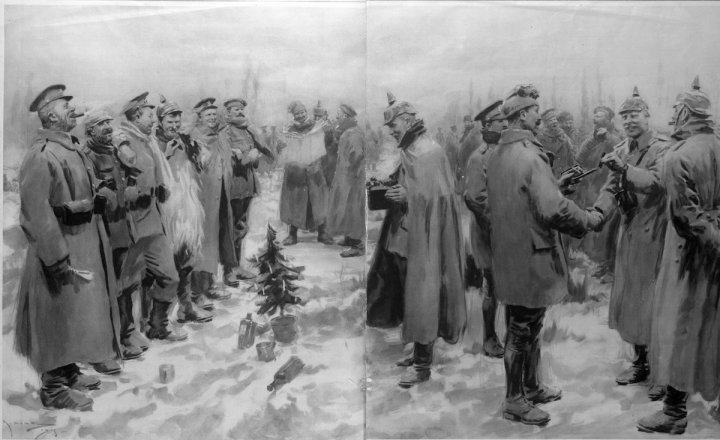
3) Years ago, two Church members in Salt Lake City were having a serious argument about some business matters. They came to President Taylor and asked him if he would listen to their story and make a decision for them. President Taylor agreed to listen. But he said, “Brethren, before I hear your case, I would like very much to sing one of the songs of Zion for you.”
President Taylor was a good singer. He enthusiastically sang a hymn to the two men. Then he sang a second and then a third hymn. Then he said, “Now, brethren, I do not want to wear you out, but if you will forgive me, and listen to one more hymn, I promise to stop singing, and will hear your case.” When President Taylor had finished the fourth song, the brethren were so touched by the hymns that they had tears in their eyes. They shook hands, apologized to President Taylor for taking up his time, and left without telling President Taylor what their problem was.
4) A group of Latter-day Saint pioneers, led by Brigham Young, were near the Rocky Mountains. One night they camped in a small valley. After supper they built a big bonfire. They sang and danced around the bonfire to help them forget their fears and worries.Before they went to bed in their wagons, leaving a single guard on duty, they sang “Come, Come, Ye Saints,” a song they used to encourage each other and show their dedication to the Lord.
That night there were a thousand unfriendly Indians hiding around the camp, ready to attack the pioneers. But after the Indians heard the pioneers sing “Come, Come, Ye Saints,” they were unable to attack. They knew the Great Spirit (their name for Heavenly Father) was watching over the pioneers, so they got on their horses and rode away, leaving the pioneers alone.
Some time later, the man who had been chief over the group of Indians told this story to some Latter-day Saint missionaries. When he finished the story, he took out a violin and began to play “Come, Come, Ye Saints.” He explained to the missionaries, “This is your song, but it is my song, too. I play it every night before I go to bed. It brings the Great Spirit here to me and makes me and my people calm and happy.” (See Lucile C. Reading, “Song of the Pioneers,")
Scientists have measured the frequencies of words and music. They have proven that words and music with certain frequencies attract like frequencies. We can attract darkness or light into our lives from the music that we listen to!
Whenever I experience contention in my home, I turn on hymns or worship music in a back bedroom or sometimes full volume throughout the house, and the contention dissipates every time. Music is powerful against the enemy!
Our Hymns
In the most recent General Conference, President Russell M. Nelson said, "When you spiritually stretch beyond anything you have ever done before, then His power will flow into you. And then you will understand the deep meaning of words we sing in the hymn “The Spirit of God”
The Spirit of God is one of my most favorite hymns. When I hear it and sing it, I feel a Divine power surge through me every time. It evokes the Spirit in a very powerful way. When I heard President Nelson say that, I felt prompted to begin to study the hymns. It was then that I realized many deep mysteries and sacred doctrines are only taught in the hymns. A perfect example of this is in the hymn Oh My Father, we sing,
"In the heav'ns are parents single? No, the thought makes reason stare!
Truth is reason; truth eternal, Tells me I've a mother there.
When I leave this frail existence, When I lay this mortal by,
Father, Mother, may I meet you, In your royal courts on high?"
From this hymn, we learn that we have a Heavenly Mother.
In the hymn, If You Could High to Kolob we learn about a place called "Kolob" that is the nearest star to our Heavenly Father's throne. A hymn written by William W. Phelps about the doctrine received in the Book of Abraham. We sing,
"If you could hie to Kolob
In the twinkling of an eye,
And then continue onward
With that same speed to fly,"
"Do you think that you could ever,
Through all eternity,
Find out the generation
Where Gods began to be?"
The Spirit of God is one of my most favorite hymns. When I hear it and sing it, I feel a Divine power surge through me every time. It evokes the Spirit in a very powerful way. When I heard President Nelson say that, I felt prompted to begin to study the hymns. It was then that I realized many deep mysteries and sacred doctrines are only taught in the hymns. A perfect example of this is in the hymn Oh My Father, we sing,
"In the heav'ns are parents single? No, the thought makes reason stare!
Truth is reason; truth eternal, Tells me I've a mother there.
When I leave this frail existence, When I lay this mortal by,
Father, Mother, may I meet you, In your royal courts on high?"
From this hymn, we learn that we have a Heavenly Mother.
In the hymn, If You Could High to Kolob we learn about a place called "Kolob" that is the nearest star to our Heavenly Father's throne. A hymn written by William W. Phelps about the doctrine received in the Book of Abraham. We sing,
"If you could hie to Kolob
In the twinkling of an eye,
And then continue onward
With that same speed to fly,"
"Do you think that you could ever,
Through all eternity,
Find out the generation
Where Gods began to be?"
I encourage you to study the hymns in the hymn book. Some of the writers of the earliest hymns were close to the prophet Joseph Smith. I can only imagine some of the glorious and wonderful things they learned that were too sacred to share in public. And I can't help but wonder if they subtly wrote about them in the hymns. I myself have been taught beautiful things by the Spirit through the hymns. I testify that if you study the hymns and learn about the writers of the hymns, you too will be taught beautiful truths through the Spirit.
What are your favorite hymns and why? I'd love for you to share below.
Lastly, I just want to share a brief history of the timeline of the LDS hymn book. Did you know each collection had a special theme? In fact, the 1908 collection is what inspired President Taylor in the story above, to sing to the two business men. They were new songs themed on Zion, and he was very much a fan. I also want to include a link to the very first hymn book. Many of these hymns are not in our current hymn book. I encourage you to study them as well, and you will love what the Spirit shares with you!
http://www.josephsmithpapers.org/paper-summary/collection-of-sacred-hymns-1835/1
Emma Smith’s Hymn Collection, 1835
Israel,” “How Firm a Foundation,” and “The Spirit of God,” are found in the 1985 edition of the hymnbook Emma’s hymnbook, entitled A Collection of Sacred Hymns for the Church of the Latter Day Saints, appeared in print in August 1835. The vest-pocket edition. 26 of the original ninety texts, including “Redeemer of .) 90 hymns
The Manchester Hymnal, 1840
One of the most important hymnals of the Church was first published in Manchester, England, in March of 1840 by Brigham Young, Parley P. Pratt, and John Taylor. Entitled A Collection of Sacred Hymns for the Church of Jesus Christ of Latter-day Saints in Europe, it contained 271 hymn texts.
The Psalmody, 1889
The new Latter-day Saints’ Psalmody, published in Salt Lake City, was the first large collection of hymns to include musical settings with the texts. According to the preface, dated 27 May 1889, this hymnal was designed “to present a suitable and acceptable tune to every hymn in the Latter-day Saints’ Hymn Book.” It included many “choir hymns”—such as “Behold the Great Redeemer Die” and “As the Dew from Heaven Distilling”—created by Latter-day Saint composers for the Tabernacle Choir’s weekly performances.
Songs of Zion, 1908
Songs of Zion was compiled by nine mission presidents in the United States and was published in 1908 by the Northern States Mission in Chicago. Included about one hundred gospel hymns, among them “Put Your Shoulder to the Wheel,” “Dear to the Heart of the Shepherd,” and “Do What Is Right.”
Deseret Sunday School Songs, 1909
Published by the Deseret Sunday School Union in 1909, Deseret Sunday School Songs was patterned after Songs of Zion, which had been well received by the Church membership. It contained favorite songs of members and choristers throughout the Church, including “In Our Lovely Deseret,” “Who’s On the Lord’s Side?” and “Count Your Blessings.” Intended for use in “Sunday School, Primary, Religion Classes, and Home Socials,” this book quickly became the most popular hymnbook in the Church.
Hymns, 1927
The General Music Committee, organized in 1920, was assigned the task of compiling a new hymnal that would combine the best of the Manchester hymnal, the Psalmody of 1889, and Songs of Zion. Although new works were secured through a hymn contest, the works of Evan Stephens and others of the older generation were the bulk of the collection. The new hymnal was entitled Latter-day Saint Hymns but was commonly referred to as the “green hymnbook.” It was used along with Deseret Sunday School Songs until 1948, when Hymns merged the two.
Hymns, 1948
In October 1943, work began on a new hymnbook. Plans were also made for a recreational songbook for youth and for a children’s songbook.
When it was published in 1948, Hymns, Church of Jesus Christ of Latter-day Saints consisted of 387 hymns. The book had four general classifications: congregation, choir, men’s voices, and women’s voices. Nearly half of the tunes in the 1948 edition of Hymns were borrowed from non-LDS sources.
This hymnal was congregation-centered. But it also contained choir selections that were generally more elaborate than those intended for congregational use.
Hymns, 1950
Two years after the 1948 edition of Hymns was published, a revision was made. This edition replaced some of the hymns in the 1948 edition with hymns from earlier LDS hymnbooks.
Hymns, 1985
Through the decades, a diverse Latter-day Saint hymnody has developed. It includes simple American hymns, appealing gospel songs, noble hymns sung by the early English Saints, hymns borrowed from other religious traditions, unique LDS choir hymns of the late 1800s, and other hymns created by Latter-day Saints.
With the 1985 edition, new hymns from this generation have been added to a balanced selection of old and borrowed hymns.
Subscribe to:
Posts (Atom)