Mosiah 18:9 - Yea, and are willing to mourn with those
that mourn; yea, and comfort those that stand in need of comfort, and to stand as a witnesses of God at all times and in all things, and in all places that ye may be in, even until death, that ye may be
redeemed of God, and be numbered with those of the first resurrection that ye may have eternal life
I am so excited to be able to finally share this here! Because it's about "the science of happiness", I hesitated sharing it here on my spiritual blog, after recently having a prompting to do so. Just a little background story: I created this workshop a couple of years ago (upon request), and it was designed to focus on the science of happiness - as it was designed for a non-religious setting. I would travel to teach it at state and government organizations to their employees. However, when I made the private recording of it in early 2016, I was able to add a bit of my own personal beliefs to it. What I loved about teaching this workshop, was that in a round-about way, it would bring people to Christ. It would get the wheels turning in their minds and people would come up to me after the class and want to talk about the gospel. They would tell me that they "felt something" and wanted to talk more about it. I would bring up scriptures that they recognized and suddenly they had this new excitement to go dust off their Bible and read it. Though I never mentioned the gospel, there are subtle annotations that point to it such as the scientific law of "like attracts like" which is essentially the "Parable of the Sower" that Jesus speaks of in the New Testament. Keep in mind that this workshop has nothing to do with religion or doctrine, it is pure science and research (though I do add my own spiritual thoughts and insight throughout). It's great for explaining how science and Christianity testify of each other. God is the creator of science and as we study the science of happiness (feelings and emotions) we can see and feel His hand in it! Because I was hired (to create and teach this workshop) I was paid very well for doing so, and therefore was unable to share it for free. When workshop participants requested to have continued access to it, I decided to make the private recorded online series that I have been selling in my store for $40.00. A couple weeks ago, I had a strong prompting to no longer sell this workshop and offer it for free to all on my YouTube channel. I took a break from speaking this year, and have decided if I pick it back up again, I'll design another workshop on a new topic. :) One thing I'd like to add is that happiness and joy are two different things. This workshop focuses on the science behind the actual feeling of happiness. Many things can help us feel happy, but joy is something of a more eternal nature. It is everlasting! That's something I have touched on this week's video message that I'm still editing. Stay tuned... Enjoy!
During conference I had the thought come into my mind that I needed to write a post titled, "The Three Types of Tares". Right after this thought, three different personality types came into my mind of people I had recently encountered last week, and I felt the Spirit teach me that in the parable of the Wheat and the Tares, there is more than meets the eye.
Over the last few weeks I have stumbled upon numerous Near Death Experience testimonies in which the person having the encounter said that they were shown Hell, and were taught something very surprising.
In one particular testimony, a man shared that while visiting Hell, the Lord had shown him a woman who resided there and was reading her Bible.
The man asked, "Who is this woman, and why is she reading a Bible in Hell?"
The Lord replied, "During her life on Earth she was an incredible evangelical missionary - the very best. In fact, she brought more people unto me, than any missionary that has ever lived!"
"Then why is she in Hell?" the man asked in a puzzled tone.
Somberly, the Lord replied, "Because she could not forgive."
I am reminded of the prodigal son. The second brother had stayed true and faithful to his father yet was filled with bitterness. The prodigal son however, made error but repented and was welcomed into his Father's Kingdom to receive an inheritance.
Doctrine & Covenants 64:9-10 9 Wherefore, I say unto you, that ye ought to forgive one another; for he that forgiveth not his brother his trespasses standeth condemned before the Lord; for there remaineth in him the greater sin.
10 I, the Lord, will forgive whom I will forgive, but of you it is required to forgive all men.
None of us are perfect and if we fall short in this life, we can rest assured that if we have extended the hand of mercy to those who have offended us, there is hope for us.
Blessed are the merciful, for they shall obtain mercy.
In another testimony, a woman was shown many Christian saints who were suffering in a state of agony and darkness. She was told by the Lord that these Christians attended church every Sunday, read their scriptures daily, prayed often, and kept the commandments. When she asked why they were in Hell, the Lord replied that even though they said and did all the "right" things to resemble a good Christian life - they never knew Him. They were void of the Spirit. The religious symbols and rituals became their idols. They loved and worshiped the lifestyle & images, more than the Lord. Matthew 7:22-23 22 Many will say to me in that day, Lord, Lord, have we not prophesied in thy name? and in thy name have cast out devils? and in thy name done many wonderful works? 23 And then will I profess unto them, I never knew you: depart from me, ye that work iniquity.
After writing this blog post, I was reading the other day in Days of Awe (which I have shared on this blog before), and I found it interesting that the author brought up the Parable of the Sower and mentioned three personality types. She said,
"The final, lingering question that Latter-day Saints ask is always the same.With all this clear, testifying imagery, why didn’t the Jews recognize their own Messiah? The Savior Himself answered that question with the Parable of the Sower (Matthew 13:3; Mark 4:3; Luke 8:5). Many Jews did recognize the Messiah. They were those who received the seed into fertile ground. Many of those were the valiant founders of the Lord’s Church, willing to face any hardship to serve the Christ." "The Savior speaks of a second type of personality — he who receives the word, but fails to nurture it. The “fear of the world” overcomes this person, and he fails to be valiant." "The third personality in the Lord’s parable is a hardened one who might activelyfight against the truth. Such were those certain wicked priests of the Sanhedrin, desiring to protect their power and position by any means available to them. Such a person was Saul, the Pharisee and lawyer, who became the Apostle Paul when his eyes were opened."
The second and third personality type sound very much like the second and third types of tares that I have listed below. In the Parable of the Wheat and the Tares we learn: Doctrine and Covenants 101:65-66 65 Therefore, I must gather together my people, according to the parable of the wheat and the tares, that the wheat may be secured in the garners to possess eternal life, and be crowned with celestial glory, when I shall come in the kingdom of my Father to reward every man according as his work shall be; 66 While the tares shall be bound in bundles, and their bands made strong, that they may be burned with unquenchable fire. Doctrine and Covenants 86:1-7 1 Verily, thus saith the Lord unto you my servants, concerning the parable of the wheat and of the tares: 2 Behold, verily I say, the field was the world, and the apostles were the sowers of the seed; 3 And after they have fallen asleep the great persecutor of the church, the apostate, the whore, even Babylon, that maketh all nations to drink of her cup, in whose hearts the enemy, even Satan, sitteth to reign—behold he soweth the tares; wherefore, the tares choke the wheat and drive the church into the wilderness. 4 But behold, in the last days, even now while the Lord is beginning to bring forth the word, and the blade is springing up and is yet tender— 5 Behold, verily I say unto you, the angels are crying unto the Lord day and night, who are ready and waiting to be sent forth to reap down the fields; 6 But the Lord saith unto them, pluck not up the tares while the blade is yet tender (for verily your faith is weak), lest you destroy the wheat also.
7 Therefore, let the wheat and the tares grow together until the harvest is fully ripe; then ye shall first gather out the wheat from among the tares, and after the gathering of the wheat, behold and lo, the tares are bound in bundles, and the field remaineth to be burned.
So, what exactly are tares and why are they so undesirable? I did some research and here's what I discovered;
The darnel weed (" Lolium Temulentum" AKA the "tares") grows plentifully in Syria and Palestine. Before it comes into ear is very similar in appearance to wheat. It grows right in with the wheat blending in and going undetected until the ear appears - that's when the difference is noticed. It actually uproots the wheat. Even then, the farmers do not try to separate it from the wheat. If eaten, it produces convulsions, and even death.
"Zizania", another type of tare, has been supposed to be degenerated wheat. On the near approach of harvest it is carefully weeded out from among the wheat by the women and children. Zuwan is commonly used as chickens' food; it is not poisonous to human beings unless infected with the mold ergot. http://www.biblestudytools.com/dictionary/tares/
In these last days, the tares are Christians and members of the Church who blend in and appear on the outside to be faithful and true. However, on the inside they hold opposing beliefs which are counteractive to gospel and doctrine of the Church. As they become attached to true and faithful members of the Church, they become destructive, and slowly pull their roots from the gospel. Once their roots have been pulled, a spiritual death begins.
As the harvest goes forth, the angels (the reapers) pluck out the wheat and burn the field.
"For they that are wise and have received the truth, and have taken the Holy Spirit for their guide, and have not been deceived—verily I say unto you, they shall not be hewn down and cast into the fire, but shall abide the day."
In our day, the tares have come to ear and are currently being exposed from the wheat. Through political upheaval, local and national turmoil, dislike and non-support of the counsel of local leaders, prophets and apostles, and leaning to blur the lines of black and white (right and wrong), there is a process happening. Many members have lost their testimony of the true doctrine of the gospel, and are inwardly void of the Spirit. As these events of the last days unfold, the tares seek to uproot their fellow church members from the gospel.This apostasy can have three outcomes - their own free choice of leaving the Church (tare #1), unwilling excommunication (tare #2), or slipping quietly into inactivity (tare #3).
It's important to be clear that the tares symbolize a wicked & rebellious heart. Not all who leave the Church are a tare. Some may be deceived and others may have fragile hearts, some may have experienced abuse or unkind treatment from other members (tares). We cannot judge another's heart - only our own. In the end we are judged by what's in our heart. If we know Christ, He will lift us up to be with Him.
Tares can also belong to other churches (other Christians). The parable is to say that tares are those who love wickedness more than righteousness. It's not members vs. non-members or less active. It's about our hearts. In these last days, the Lord is gathering the pure in heart into Zion.
“Charity is the pure love of Christ, and it endureth forever; and whoso is found possessed of it at the last day, it shall be well with him. Wherefore, my beloved brethren, pray unto the Father with all the energy of heart, that ye may be filled with this love, which he hath bestowed upon all who are true followers of his Son, Jesus Christ” (Moroni 7:47-48).
I have recently witnessed this week, the separation of wheat and tares happening on a wider scale. I have noticed a large number of people being offended by recent conference talks, people fighting over differing views and opinions on growing political matters, people fighting over differing opinions and views on philosophical matters, medical matters, doctrinal matters, educational matters etc. to the point that marriages are being broken up, family relationships are being broken, friends are no longer speaking, professionals are verbally attacking their colleagues, and people are vocally leaving the church. I counted fourteen people just today, who have declared they no longer want to be members of the Church. Perhaps tares who had already apostatized inwardly and tarried until the "right moment" to make their exit. As the various matters for contention continue to increase I keep hearing in the back of my mind..."And the love of men shall wax cold".
President Joseph Fielding Smith pointed out that the tares are not just limited to certain church affiliations. He said, “even in the Church the tares are to be found. It is the tares which are to be gathered up and burned from all over the world, but those in the Church will also be gathered out and find their place in the fire. (Church History and Modern Revelation, 1:354.)
In 1894 President Woodruff stated: “God has held the angels of destruction for many years, lest they should reap down the wheat with the tares. But I want to tell you now, that those angels have left the portals of heaven, and they stand over this people and this nation now, and are hovering over the earth waiting to pour out the judgments. And from this very day they shall be poured out. Calamities and troubles are increasing in the earth, and there is a meaning to these things. Remember this, and reflect upon these matters. If you do your duty, and I do my duty, we’ll have protection, and shall pass through the afflictions in peace and in safety.” (Young Women’s Journal, Aug. 1894, pp. 512–13.)
Years later in response to President Woodruff's statement above, President Joseph Fielding Smith said, “The Lord said that the sending forth of these angels was to be at the end of the harvest, and the harvest is the end of the world. Now, that ought to cause us some very serious reflections. And the angels have been pleading, as I have read it to you, before the Lord to be sent on their mission. Until 1893 the Lord said to them no, and then He set them loose. According to the revelation of President Woodruff, the Lord sent them out on that mission." “What do we gather out of that? That we are at the time of the end. This is the time of the harvest. This is the time spoken of which is called the end of the world.” (Signs of the Times, pp. 116–21.) https://www.lds.org/manual/doctrine-and-covenants-student-manual/section-81-89/section-86-the-parable-of-the-wheat-and-the-tares?lang=eng
Three Types of Tares
Last week the Spirit impressed upon my mind, three types of tares that we are to be aware of.
1) Wicked - These are those whose hearts' desire are pure wickedness. They have chosen the other side of the fence. The wolves in sheep's clothing. They knowingly do evil and willfully sin. They desire to lure and persuade others away from the truth. Led away by sin without a desire to repent. These are those in the Great and Spacious building - mocking things that are sacred.
2) Self-Righteous - These are those who often are unknowingly doing the devil's bidding. They believe they are on the right side of the fence, but are deceived. They actively and unknowingly fight against truth, and are easily offended. The pharisees of our modern day. They twist doctrines and present themselves as faithful members of the Church but are in reality servants of Satan. Often hypocritical, and quick to point out the faults of others. They are on a mission to attack other members who do not share their same perspectives. A justified crusade of self-righteous anger displayed through manipulative tactics. So passionate are they about being "right" that they lose the Spirit as it swallowed up in their own pride. They become a source of temptation to the faithful and tend to choke or corrupt the word of God, or the good seed that is sown.
3) Ignorant - These are those who refuse to learn and accept truth because of fear. They have received the word but fail to nurture it. They live the gospel when it's convenient. Often they are the ones who are easily lured away from the iron rod, by those in the Great and Spacious Building. In their mind it is safer to be "in the dark" to avoid accountability. They want to participate in Babylon without feeling "guilty" for doing so. They want to be on both sides of the fence, but because that is not possible, they settle for the middle. Their hearts are rooted in the world instead of the gospel. They enjoy the benefits of being a member of the church - the traditions, the social aspects, the fun activities; but they also value the opinions of the world. They try to serve two masters.
Conclusion
The purpose of this post is not to go about your day looking to label those in your family, ward, and community with these tare titles. We are commanded to love one another. Rather, it is to help you look inward at your own faults and short comings and seek to improve. Do you see yourself in any of these descriptions? What is written in your heart? How can you change?
We can love ourselves and all of God's children without tolerating the darkness. I have experienced recent bullying from all three types of tares in the last month. The Spirit has impressed upon me to not publish their comments, to block their contact, and then pray for them. Pray that they will be able to encounter the real love of Jesus Christ. That they will no longer be void of peace and happiness. I try my best to see them through the eyes of my Heavenly Father, and the truth of who they really are and the potential of who they can become.
Though we are not called to judge, we are called to warn our neighbor. Elder Christopherson has wisely counseled, "While the duty to warn is felt especially keenly by prophets, it is a duty shared by others as well. In fact, “it becometh every man who hath been warned to warn his neighbor." We who have received a knowledge of the great plan of happiness—and its implementing commandments—should feel a desire to share that knowledge since it makes all the difference here and in eternity. And if we ask, “Who is my neighbor that I should warn?” surely the answer will be found in a parable that begins, “A certain man went down from Jerusalem to Jericho, and fell among thieves,”and so forth."
We have seen amazing examples of tares transforming into wheat such as was the case of Saul of Tarsus and Alma the Younger. The real battle is not between God's children, but between good and evil. Without the influence of evil, we would experience all of our brothers and sisters in God's truth. No, it's not our job to judge, but rather it's our great responsibility to warn and to bring Light into this world. That Light is God's truth. Our job is to reflect the Light of the Lord and shine it throughout the world. Only the Light and Love of Christ can change this world. In the end love conquers all.
The harvest is happening now. We are seeing the separation take place. Let us find peace in the words of President Woodruff, "If you do your duty, and I do my duty, we’ll have protection, and shall pass through the afflictions in peace and in safety.” Though we may not be immune to every coming storms & affliction, and we most likely will experience some level of discomfort, inconvenience, sorrow & loss; we certainly don't have to suffer. We can experience the peace that is promised through our Lord and Redeemer Jesus Christ. He is mighty to save. He can make us whole.
A few weeks ago, I taught my son's primary class at church. I was so excited that the lesson was all about the hymn book. Whenever I teach a lesson, I always go the extra mile and put forth all my passion into the lesson. When I substitute primary, the kids feed off of my passion and the Spirit is always so strong.
Truly, I believe that children today hunger for truth. When lessons are watered down, generic, or void of the Spirit, the kids lose interest. There were kids in my son's class who (according to my son) normally disrupt and struggle to focus or participate - who happened to be the most participating kids in the class that day. They were eager to learn and feel the Spirit. They smiled, shared thoughts, asked questions and didn't want the lesson to come to an end. When I realized time had run out, they begged me to go five minutes over so they could hear the rest of the lesson. There was a wonderful Spirit in the class that day and we had an incredible discussion about the power of music!
The lesson had such an impact on the children, that one of the boys volunteered to sing a solo during music time in front of the entire primary. His father was quite surprised, as I guess he normally doesn't do that sort of thing. He sang with the sweetest voice, the most beautiful song, and he tried his best. I really felt that the lesson made an impact in his life.
The lesson was about the Hymn Book and how Emma Smith was commissioned to create a book of hymns for the early saints. I felt impressed to take it a step further, and talk with the kids about why music is so important. They told me they had no idea! So, I thought I would share the material we talked about here on my blog.
Why do we sing at church?
We sing at the opening of the sacrament meeting, then we sing again prior to blessing the sacrament, then we sing an intermission hymn, then we sing another hymn to close the meeting. So, why is music such a big part of our church meetings? Music is a language. It’s the language of the Spirit. Your Spirit speaks that language and that’s why you feel really good when you hear certain songs. The adversary also uses music as a language. Some songs make us feel down, anxious, negative, or depressed. Brigham Young once said: “There is no music in hell, for all good music belongs to heaven". What difference do you think it would make if we didn't sing church meetings?
I once had a young bishop (who was the same age as me) in an old ward, who took music very seriously. On more than one occasion he would interrupt the hymns in sacrament meeting (mid singing) and ask the congregation to start over. He would give a quick sermon about the importance of "everyone" singing, and remind us that hymns are prayers. If he saw people not singing, or the congregation was singing too quietly he would do this every time. Eventually the ward got better at taking the hymns more seriously. They would sing with boldness, with passion, and with the Spirit. It truly improved our meetings and invited the Spirit in, and very much improved fast and testimony meetings.
Boyd K. Packer once said, “Music is of enormous importance in our worship services. I believe that those who choose, conduct, present, and accompany the music may influence the spirit of reverence in our meetings more than a speaker does”
I remember once while serving as first counselor in the primary presidency, being told to always let music time go longer if needed. Never cut it short to make time for the sharing time lesson, because the music was more important. At the time I didn't understand and I always felt sad when music time cut so much into my lesson that I was only left with 6 minutes to teach. Of course, I don't feel that way anymore.
The First Presidency of the Church has said, “Brothers and sisters, let us use the hymns to invite the spirit of the Lord into our congregations, our homes, and our personal lives. Let us memorize and ponder them, recite and sing them, and partake of their spiritual nourishment. Know that the song of the righteous is a prayer unto our Father in Heaven, ‘and it shall be answered with a blessing upon [your] heads’”
I have found that there are three ways that music works as a power in our lives.
1) Power of Worship
David was a son of Jesse of the tribe of Judah. He was a courageous youth who slew a lion, a bear, and the Philistine giant Goliath (1 Sam. 17). David was chosen and anointed to be king of Israel. David was also a skilled musician and while king, he created a vast musical program in which four thousand Levites were selected as musicians and trained for the elaborate choral and instrumental music that was introduced by David into the religious services of Israel. The entire book of Psalms which translates in Hebrew as "praises", is in essence a book of songs and David is accredited as it's author. The Psalms were written not merely as poems, but as worship songs for singing.
More than a third of the psalms are addressed to the Director of Music. Some psalms exhort the worshiper to sing (e.g. Pss. 33:1-3; 92:1-3; 96:1-3; 98:1; 101:1; 150). Some Psalms were to be accompanied by stringed instruments (Neginah, Neginoth Ps. 4; 54–55; 61; 67; 76; and Hab. 3:19), others by wind instruments (Nehiloth Ps. 5); while such titles as “Set to Alamoth” (“maidens,” Ps. 46), or “Set to the Sheminith” (“the octave,” Ps. 6; 12), seem to imply that there was singing in parts. Some of the titles appear to be intended to indicate the character of the Psalm, as Maschil (“giving instruction,” Ps. 32; 42; 44–45; 52–55; 74; 78; and 88–89), Michtam, rendered by some Golden Psalm (Ps. 16; 56–60); while Shiggaion (Ps. 7) with Shigionoth (Hab. 3:1) may refer to the irregular erratic style of the compositions, and Gittith (“belonging to Gath,” Ps. 8; 81; 84) may relate either to the melody or to the instrument used in the performance. The other titles are all probably names of tunes, well known at the time, to which the Psalms were appointed to be sung. https://en.wikipedia.org/wiki/Psalms https://www.lds.org/scriptures/bd/psalms
Masoretic cantillation, is the ritual chanting of readings from the Hebrew Bible in synagogue services. The chants are written and notated in accordance with the special signs or marks printed in the Masoretic text of the Hebrew Bible (or Tanakh) to complement the letters and vowel points. David. C. Mitchell discovered that when applying Psalm 114 to the Masoretic cantillation, a melody can be found that is recognizable as the tonus peregrinus of church and synagogue. https://en.wikipedia.org/wiki/Psalms
New Testament references show that the earliest Christians used the Psalms in worship, and the Psalms have remained an important part of worship in most Christian Churches. In fact, some Christian denominations only sing Psalms in their services, and no other non-Biblical hymns.
Many Near Death Experience encounters, testify of hearing music of praise and worship when they cross through the veil. In fact, many witnesses speak of angels, plants, flowers and even animals singing praises about them as they pass through the veil. Music appears to be a language that is widely used in the Heavenly spirit realm.
In a recent post, I shared a discovery of the sounds of crickets being slowed down to reveal a Heavenly chorus of worship and praise music. It is no wonder in the hymn, Sing Praise to Him we hear the words, "All creatures of our God and King,. Lift up your voice and with us sing" I believe the Lord created all creatures to sing praises unto Him. I can't help but notice that the word "create" is found in the word "creature". All of the Lord's creations were made with purpose, and made for praise, and to testify of the goodness of the Lord.
In Pslams 148, David exhorts all creatures, animals and people to:
7 Praise the Lord from the earth, ye dragons, and all deeps: 8 Fire, and hail; snow, and vapour; stormy wind fulfilling his word: 9 Mountains, and all hills; fruitful trees, and all cedars: 10 Beasts, and all cattle; creeping things, and flying fowl: 11 Kings of the earth, and all people; princes, and all judges of the earth: 12 Both young men, and maidens; old men, and children:
2) Power of Healing
Music used for healing can be traced back to the creation of the Chinese characters because the word for medicine (yao) comes from the word for music (yue). Music purifies and uplifts the soul. https://www.andywasserman.com/arts-in-ed/holistic-music-healing
In some of the books I have written, and in my workshops and presentations, I teach about the healing power of music. One research study that I often speak about is that of John Hutchinson, an electro-magnetic energy expert from Vancouver, B.C. Canada, who has verified that a certain selection of “music” has helped purify poisoned water. Using the 528Hz frequency, known as the love/DNA repair frequency, he and his partner Nancy Lazaryan were able to heal water from the Gulf Oil Spill in 2010. The frequencies they selected have been shown scientifically to reduce the oil and grease in polluted waters in the Gulf of Mexico from 7 ppm to less than 1 ppm, restoring the water's vitality as manifest by the return of fish, dolphins and even barnacles to a region of Perdido Bay in Lillian, Alabama, USA, where they conducted their first test. The area was treated with the frequencies for four hours the first day, and by the next morning, the waters were cleared.
Dr. Masaru Emoto is world renowned for his research with water. You may have heard of the rice jar experiments that children often do in science class. The student takes two jars filled with rice and water. For 30 days they speak kinds words and play beautiful music to one jar, and unkind words and unpleasant music to the other jar. After the 30 days the rice in "unkind" jar turns putrid and black. The rice in the "kind" jar stays white and clean.
Dr. Emoto can be credited for these experiments stemming from his research. Emoto's water crystal experiments consisted of exposing water in glasses to different words, pictures or music, and then freezing and examining the aesthetic properties of the resulting crystals with microscopic photography. Emoto made the claim that water exposed to positive speech and thoughts would result in visually "pleasing" crystals being formed when that water was frozen, and that negative intention would yield "ugly" frozen crystal formations.
I too, can vouch for music working as a tool for healing. There have been countless times I have played music with a 528 Hz frequency around my children when they have been injured or sick and we have experienced miracles. I believe that because God is love, when we are in tune with Him, we are aligned with His will and therefore sync ourselves to the 528 Hz frequency. Unconditional love heals and unconditional love is who God is.
Ancient civilizations understood the powerful benefit of sound and vibration. They composed music based on the perfect mathematical proportions that can be found in the construction of many sacred temples, space, and time. These tones are used in the Gregorian chants of the western Roman Catholic Church.
The original Solfeggio scale was developed by a Benedictine monk, Guido d’Arezzo (c. 991 AD – c. 1050 AD). It was used by singers to learn chants and songs more easily. Today we know the Solfeggio scale as seven ascending notes assigned to the syllables Do-Re-Mi-Fa-So-La-Ti. The original scale was six ascending notes assigned to Ut-Re-Mi-Fa-Sol-La. The syllables for the scale were taken from a hymn to St. John the Baptist, Ut Queant Laxis, written by Paulus Diaconus.
Guido d’Arezzo. In the mid-1970’s Dr. Joseph Puleo, a physician and America’s leading herbalist, found six electro-magnetic sound frequencies that corresponded to the syllables from the hymn to St. John the Baptist. https://attunedvibrations.com/solfeggio/
In many cultures today, notes on the scale and music written in certain keys, are used as medicine to heal specific areas of the body. Best Selling Deseret Book authors Karol Truman and Carol Tuttle both have written about this topic. I've had the privilege to meet with Karol Truman and interview her about music and healing. She shared with me that her husband Delmont, has the gift of healing through his singing voice. His voice is perfectly pitched in such a way that when he sings, he heals people. Karol herself has also written music that she feels was Divinely inspired, that heals the mind, body, and soul.
Karol says, "Each of us has every note of the musical scale in our body and speaking voice. Every note corresponds to an energy center in our body. Many of us however, are lacking the note of B,Sadly, this is our Spiritual energy center. By listening to music in the Key of B, you can help restore the B note in your body/voice."
She shared with me a special story about a friend of hers who had the gift of recognizing notes that were missing in a person's voice. If someone was sick, she could detect the missing note/frequency and be able to sing that frequency/note back into their being. Her friend's son was one day very ill in the hospital. She called him on the phone and detected the missing note in his voice. When she got to the hospital she was able to sing him back to wellness!
I believe that our sacred hymns not only heal because of their words (there is power in the Word) but because of the music itself. There is Divine power in the notes themselves. It is the language of the Spirit the language of Heaven. We can cast out darkness through prayer and we can cast out darkness when we sing or play a hymn. When we cast out darkness, powerful healing can take place.
3) Power of Warfare
Music has been used in warfare all throughout the ages of man. Chapter 6 of the Old Testament’s book of Joshua, contains an exceptionally detailed description of the deployment of ram’s horns used in warfare against Jericho, the oldest fortified human settlement known to archaeology. Although ram’s horns do indeed make a powerful blast of sound. Priests blowing their horns in unison, fired up his warriors and weakened the Canaanites’ will to resist, and the entire city wall came crumbling to the ground.
Bagpipes, drums, horns, and flutes, have all been used on the battlefield. Music is a language and code in battle. I believe the same to be true with spiritual warfare. We can fight off the powers of darkness with praise and worship music - especially hymns.
Though music is used in battle, it has often been used on the battlefield to establish peace. Here are four examples:
1) During the American Civil War, musical duels between the two sides were common, as they heard each other as the music traveled across the countryside. The night before the Battle of Stones River, bands from both sides dueled with separate songs, until both sides started playing Home! Sweet Home!, at which time soldiers on both sides started singing together as one. A similar situation occurred in Fredericksburg,Virginia in the winter of 1862–3. On a cold afternoon a Union band started playing Northern patriotic tunes; a Southern band responded by playing Southern patriotic tunes. This back and forth continued into the night, until at the end both sides played Home! Sweet Home! simultaneously, to the cheers of both sides' forces. In a third instance, in the spring of 1863, the opposing armies were on the opposite sides of the Rappahannock River in Virginia, when the different sides played their patriotic tunes, and at taps one side played Home! Sweet Home!, and the other joined in, creating "cheers" from both sides that echoed throughout the hilly countryside.
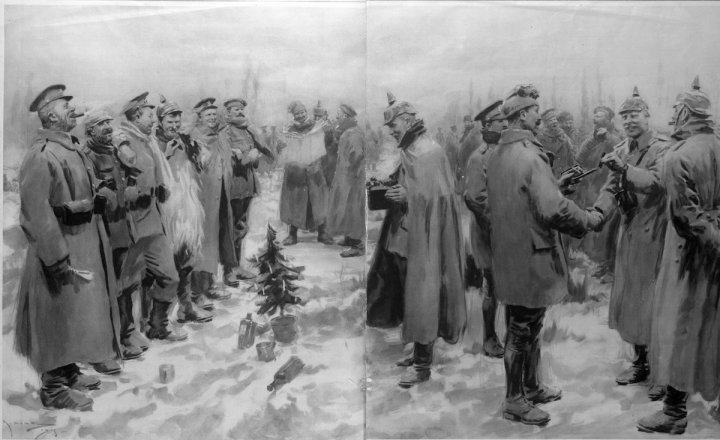
2) During World War I, one morning 100 years ago, thousands of British, Belgian and French soldiers put down their rifles, stepped out of their trenches and spent Christmas mingling with their German enemies along the Western front. Most accounts suggest the truce began with carol singing from the trenches on Christmas Eve, "a beautiful moonlit night, frost on the ground, white almost everywhere", as Pvt. Albert Moren of the Second Queens Regiment recalled.
“First the Germans would sing one of their carols and then we would sing one of ours, until when we started up ‘O Come, All Ye Faithful’ the Germans immediately joined in singing the same hymn to the Latin words Adeste Fideles. And I thought, well, this is really a most extraordinary thing – two nations both singing the same carol in the middle of a war.”
The next morning, in some places, German soldiers emerged from their trenches, calling out “Merry Christmas” in English. Allied soldiers came out warily to greet them. In others, Germans held up signs reading "You no shoot, we no shoot." Over the course of the day, troops exchanged gifts of cigarettes, food, buttons and hats. The Christmas truce also allowed both sides to finally bury their dead comrades, whose bodies had lain for weeks on "no man's land," the ground between opposing trenches.http://time.com/3643889/christmas-truce-1914/
3) Years ago, two Church members in Salt Lake City were having a serious argument about some business matters. They came to President Taylor and asked him if he would listen to their story and make a decision for them. President Taylor agreed to listen. But he said, “Brethren, before I hear your case, I would like very much to sing one of the songs of Zion for you.”
President Taylor was a good singer. He enthusiastically sang a hymn to the two men. Then he sang a second and then a third hymn. Then he said, “Now, brethren, I do not want to wear you out, but if you will forgive me, and listen to one more hymn, I promise to stop singing, and will hear your case.” When President Taylor had finished the fourth song, the brethren were so touched by the hymns that they had tears in their eyes. They shook hands, apologized to President Taylor for taking up his time, and left without telling President Taylor what their problem was.
4) A group of Latter-day Saint pioneers, led by Brigham Young, were near the Rocky Mountains. One night they camped in a small valley. After supper they built a big bonfire. They sang and danced around the bonfire to help them forget their fears and worries.Before they went to bed in their wagons, leaving a single guard on duty, they sang “Come, Come, Ye Saints,” a song they used to encourage each other and show their dedication to the Lord.
That night there were a thousand unfriendly Indians hiding around the camp, ready to attack the pioneers. But after the Indians heard the pioneers sing “Come, Come, Ye Saints,” they were unable to attack. They knew the Great Spirit (their name for Heavenly Father) was watching over the pioneers, so they got on their horses and rode away, leaving the pioneers alone.
Some time later, the man who had been chief over the group of Indians told this story to some Latter-day Saint missionaries. When he finished the story, he took out a violin and began to play “Come, Come, Ye Saints.” He explained to the missionaries, “This is your song, but it is my song, too. I play it every night before I go to bed. It brings the Great Spirit here to me and makes me and my people calm and happy.” (See Lucile C. Reading, “Song of the Pioneers,")
Scientists have measured the frequencies of words and music. They have proven that words and music with certain frequencies attract like frequencies. We can attract darkness or light into our lives from the music that we listen to!
Whenever I experience contention in my home, I turn on hymns or worship music in a back bedroom or sometimes full volume throughout the house, and the contention dissipates every time. Music is powerful against the enemy!
Our Hymns
In the most recent General Conference, President Russell M. Nelson said, "When you spiritually stretch beyond anything you have ever done before, then His power will flow into you. And then you will understand the deep meaning of words we sing in the hymn “The Spirit of God” The Spirit of God is one of my most favorite hymns. When I hear it and sing it, I feel a Divine power surge through me every time. It evokes the Spirit in a very powerful way. When I heard President Nelson say that, I felt prompted to begin to study the hymns. It was then that I realized many deep mysteries and sacred doctrines are only taught in the hymns. A perfect example of this is in the hymn Oh My Father, we sing, "In the heav'ns are parents single? No, the thought makes reason stare! Truth is reason; truth eternal, Tells me I've a mother there. When I leave this frail existence, When I lay this mortal by, Father, Mother, may I meet you, In your royal courts on high?"
From this hymn, we learn that we have a Heavenly Mother.
In the hymn, If You Could High to Kolob we learn about a place called "Kolob" that is the nearest star to our Heavenly Father's throne. A hymn written by William W. Phelps about the doctrine received in the Book of Abraham. We sing, "If you could hie to Kolob In the twinkling of an eye, And then continue onward With that same speed to fly," "Do you think that you could ever, Through all eternity, Find out the generation Where Gods began to be?"
I encourage you to study the hymns in the hymn book. Some of the writers of the earliest hymns were close to the prophet Joseph Smith. I can only imagine some of the glorious and wonderful things they learned that were too sacred to share in public. And I can't help but wonder if they subtly wrote about them in the hymns. I myself have been taught beautiful things by the Spirit through the hymns. I testify that if you study the hymns and learn about the writers of the hymns, you too will be taught beautiful truths through the Spirit.
What are your favorite hymns and why? I'd love for you to share below.
Lastly, I just want to share a brief history of the timeline of the LDS hymn book. Did you know each collection had a special theme? In fact, the 1908 collection is what inspired President Taylor in the story above, to sing to the two business men. They were new songs themed on Zion, and he was very much a fan. I also want to include a link to the very first hymn book. Many of these hymns are not in our current hymn book. I encourage you to study them as well, and you will love what the Spirit shares with you! http://www.josephsmithpapers.org/paper-summary/collection-of-sacred-hymns-1835/1
Emma Smith’s Hymn Collection, 1835
Israel,” “How Firm a Foundation,” and “The Spirit of God,” are found in the 1985 edition of the hymnbook Emma’s hymnbook, entitled A Collection of Sacred Hymns for the Church of the Latter Day Saints, appeared in print in August 1835. The vest-pocket edition. 26 of the original ninety texts, including “Redeemer of .) 90 hymns
The Manchester Hymnal, 1840
One of the most important hymnals of the Church was first published in Manchester, England, in March of 1840 by Brigham Young, Parley P. Pratt, and John Taylor. Entitled A Collection of Sacred Hymns for the Church of Jesus Christ of Latter-day Saints in Europe, it contained 271 hymn texts.
The Psalmody, 1889
The new Latter-day Saints’ Psalmody, published in Salt Lake City, was the first large collection of hymns to include musical settings with the texts. According to the preface, dated 27 May 1889, this hymnal was designed “to present a suitable and acceptable tune to every hymn in the Latter-day Saints’ Hymn Book.” It included many “choir hymns”—such as “Behold the Great Redeemer Die” and “As the Dew from Heaven Distilling”—created by Latter-day Saint composers for the Tabernacle Choir’s weekly performances. Songs of Zion, 1908
Songs of Zion was compiled by nine mission presidents in the United States and was published in 1908 by the Northern States Mission in Chicago. Included about one hundred gospel hymns, among them “Put Your Shoulder to the Wheel,” “Dear to the Heart of the Shepherd,” and “Do What Is Right.”
Deseret Sunday School Songs, 1909
Published by the Deseret Sunday School Union in 1909, Deseret Sunday School Songs was patterned after Songs of Zion, which had been well received by the Church membership. It contained favorite songs of members and choristers throughout the Church, including “In Our Lovely Deseret,” “Who’s On the Lord’s Side?” and “Count Your Blessings.” Intended for use in “Sunday School, Primary, Religion Classes, and Home Socials,” this book quickly became the most popular hymnbook in the Church.
Hymns, 1927
The General Music Committee, organized in 1920, was assigned the task of compiling a new hymnal that would combine the best of the Manchester hymnal, the Psalmody of 1889, and Songs of Zion. Although new works were secured through a hymn contest, the works of Evan Stephens and others of the older generation were the bulk of the collection. The new hymnal was entitled Latter-day Saint Hymns but was commonly referred to as the “green hymnbook.” It was used along with Deseret Sunday School Songs until 1948, when Hymns merged the two.
Hymns, 1948
In October 1943, work began on a new hymnbook. Plans were also made for a recreational songbook for youth and for a children’s songbook.
When it was published in 1948, Hymns, Church of Jesus Christ of Latter-day Saints consisted of 387 hymns. The book had four general classifications: congregation, choir, men’s voices, and women’s voices. Nearly half of the tunes in the 1948 edition of Hymns were borrowed from non-LDS sources.
This hymnal was congregation-centered. But it also contained choir selections that were generally more elaborate than those intended for congregational use.
Hymns, 1950
Two years after the 1948 edition of Hymns was published, a revision was made. This edition replaced some of the hymns in the 1948 edition with hymns from earlier LDS hymnbooks.
Hymns, 1985
Through the decades, a diverse Latter-day Saint hymnody has developed. It includes simple American hymns, appealing gospel songs, noble hymns sung by the early English Saints, hymns borrowed from other religious traditions, unique LDS choir hymns of the late 1800s, and other hymns created by Latter-day Saints.
With the 1985 edition, new hymns from this generation have been added to a balanced selection of old and borrowed hymns.